Sun Safety
The best sunscreen sticks
The format you will actually reapply, and the technique that decides whether it is doing anything.
Disclosure: Spf & Shore earns commission from qualifying purchases made through links on this page, at no extra cost to you. It does not change which products we recommend. Read the full disclosure.
Our pick is the EltaMD UV Stick Broad Spectrum SPF 50+: 22% transparent zinc oxide as the only active filter, 80 minutes of water resistance, and no added fragrance, in 1.3 ounces of product — a lot of stick by the standards of this category.
One thing decides whether any of this matters: a stick is a precision tool, not a faster way to cover a body. The SPF on the tube was measured at a laboratory dose that one quick swipe does not come close to. Four slow passes back and forth over an area, then blending with your fingers, is the version of the job that gets you near the number. Everything below assumes you will do that.
Quick picks
Tap any row to read the full write-up below.
| # | Product | Best for | Price |
|---|---|---|---|
| 1 | 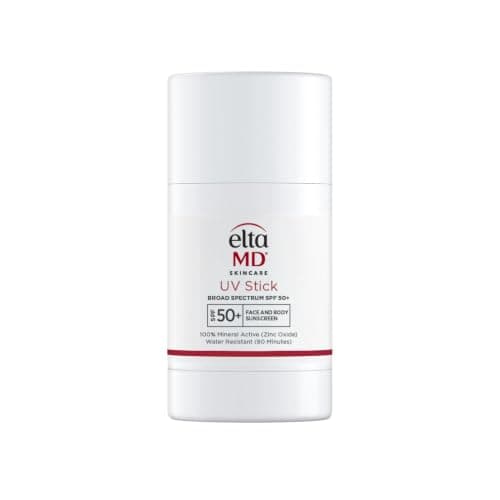 EltaMD UV Stick Broad Spectrum SPF 50+Best overall · SPF 50+ | Daily face use and reapplication on anyone, including sensitive skin | |
| 2 | 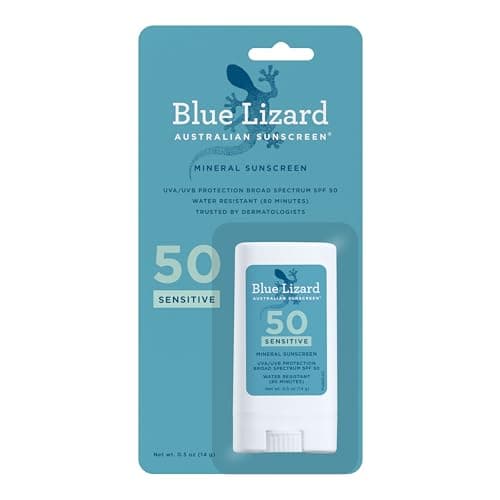 Blue Lizard Sensitive Mineral Sunscreen Stick SPF 50+Best value · SPF 50+ | Buying three and leaving one in every bag | $8.60 · View on Amazon #ad We earn from qualifying purchases · Price as of October 2, 2026 |
| 3 | 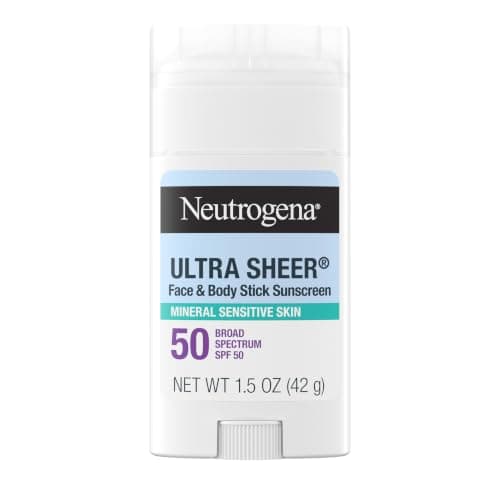 Neutrogena Ultra Sheer Face & Body Mineral Sunscreen Stick SPF 50Most product per tube · SPF 50 | Shoulders, ears and the tops of feet as well as a face | $12.99 · View on Amazon #ad We earn from qualifying purchases · Price as of October 2, 2026 |
| 4 | 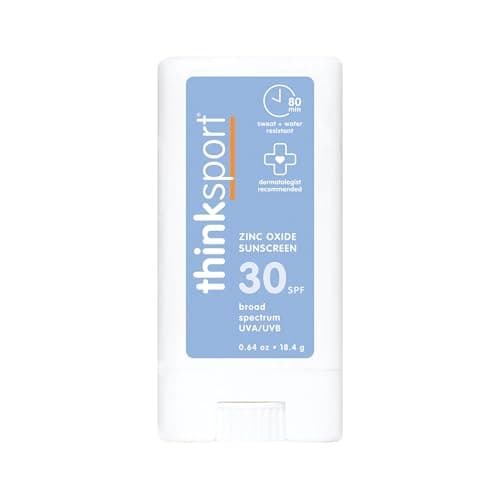 Thinksport Sunscreen Stick SPF 30+Best for sweat and sport · SPF 30+ | Long exposed days — trail, water, field and snow | $9.99 · View on Amazon #ad We earn from qualifying purchases · Price as of October 2, 2026 |
| 5 | 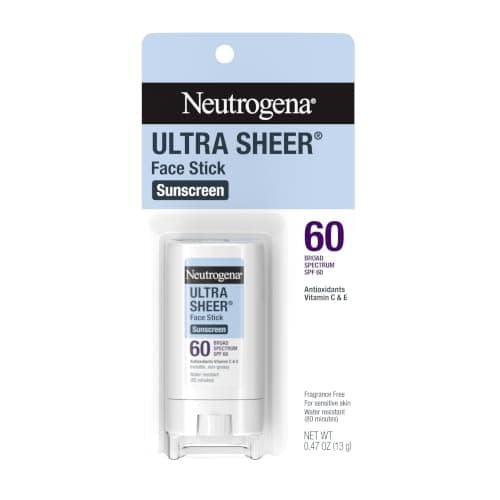 Neutrogena Ultra Sheer Face Sunscreen Stick SPF 60Best if you refuse any white cast · SPF 60 | Deeper skin tones, and anyone who will not wear a mineral film | $10.88 · View on Amazon #ad We earn from qualifying purchases · Price as of October 2, 2026 |
How we chose these
Broad spectrum and SPF 30 or higher as the floor, which is the American Academy of Dermatology's standing guidance. Four of the five picks are SPF 50 or better. Then 80 minutes of water resistance rather than 40, because the whole argument for a stick is that it travels with you to the places where you sweat and swim.
After that we preferred zinc-only actives panels and fragrance-free bases, because a stick gets used on faces, around eyes and on the backs of children's necks more than any other format. We read the actives panel for every product on the brand's own US product page or on its DailyMed OTC drug label, and we confirmed each one had a working add-to-cart on the day this page was written. We do not run a lab and we do not wear-test, so there are no scores here. Where an independent organization has tested — Consumer Reports lab-verifies label SPF — we name them rather than restating their findings as ours. Our methodology.
Three sticks that routinely appear on lists like this one are not here, and the reasons are worth stating. Sun Bum's Mineral SPF 50 Face Stick and Raw Elements' Tinted Face Stick SPF 30 were both out of stock on their own brand stores when we checked. Neutrogena's Ultra Sheer Face & Body Stick SPF 70 is labeled discontinued on Neutrogena's own site. We do not list products we cannot confirm you can buy.
The dose problem, and how to beat it
Every SPF number on every sunscreen in the United States comes from testing at a fixed, generous dose of product per area of skin. Lotion makes that dose visible: you can see a white layer and work it in. A stick hides it. The wax base means a single pass leaves a film you can barely feel, at a fraction of the tested amount, and nothing about the experience tells you that you have under-applied.
The practical fix is simply to swipe more than feels necessary. Our working rule is four passes back and forth over each area, until the skin looks faintly shiny or chalky, then blend with your fingertips. That is our editorial guidance rather than a label instruction, and it is deliberately more than most people do. How much sunscreen to apply covers the underlying volumes for every format.
What is actually in these five
The marketing on the front of a stick tells you very little. The actives panel on the back tells you everything that matters, and the five below are not interchangeable.
| Stick | Active filters | SPF | Water resistance |
|---|---|---|---|
| EltaMD UV Stick | 22% transparent zinc oxide | SPF 50+ | 80 minutes |
| Blue Lizard Sensitive Stick | 20% zinc oxide | SPF 50+ | 80 minutes |
| Neutrogena Ultra Sheer Face & Body Mineral Stick | 21.6% zinc oxide | SPF 50 | 80 minutes |
| Thinksport Sunscreen Stick | 24% zinc oxide | SPF 30+ | 80 minutes |
| Neutrogena Ultra Sheer Face Stick | Avobenzone 3%, homosalate 15%, octisalate 5%, octocrylene 10% | SPF 60 | 80 minutes |
Four of the five are zinc-only, which is why they are the ones we lead with. The fifth is a chemical-filter stick, and it is on this page for one specific reason covered further down: it is the only one of the five that genuinely leaves nothing visible on any skin tone.
Our picks in detail
01 · Best overall
EltaMD UV Stick Broad Spectrum SPF 50+
EltaMD · Read our EltaMD review
22% transparent zinc oxide as the only active filter, 80 minutes of water resistance, fragrance-free, dye-free and non-comedogenic, in 1.3 ounces of product. It is the most defensible actives panel in the category paired with a base that does not irritate, which is why it is the one we would hand to someone with no other information.
- Actives:
- 22% transparent zinc oxide
- SPF:
- SPF 50+
- Water resistance:
- 80 minutes
- Reef status:
- Zinc only — no oxybenzone, octinoxate or octocrylene
- Best for:
- Daily face use and reapplication on anyone, including sensitive skin
What works
- Zinc-only, so unrestricted under every reef law
- Fragrance-free, dye-free and non-comedogenic
- 1.3 ounces, which is a generous amount of stick
The trade-off
- Priced like a dermatologist-counter product, not a drugstore one
- Still needs working in on medium and deep skin tones
- The wax base drags on very dry skin until it warms up
02 · Best value
Blue Lizard Sensitive Mineral Sunscreen Stick SPF 50+
Blue Lizard · Read our Blue Lizard review
20% zinc oxide, 80 minutes of water resistance, fragrance-free, paraben-free and dye-free, at a price low enough that you can own several. Owning several is the actual trick with sticks, because the one in your pocket is the only one that gets used.
- Actives:
- 20% zinc oxide
- SPF:
- SPF 50+
- Water resistance:
- 80 minutes
- Reef status:
- Zinc only — no oxybenzone, octinoxate or octocrylene
- Best for:
- Buying three and leaving one in every bag
What works
- Zinc-only actives at the lowest price here
- Fragrance-free and formulated for sensitive skin
- Cheap enough to keep duplicates in car, bag and jacket
The trade-off
- Smaller than the EltaMD stick, so it runs out faster
- Visible cast until it is worked in
- Thicker drag on application than the sheerer face sticks
#ad We earn from qualifying purchases · Price as of October 2, 2026
03 · Most product per tube
Neutrogena Ultra Sheer Face & Body Mineral Sunscreen Stick SPF 50
Neutrogena
21.6% zinc oxide with 80 minutes of water resistance in a 1.5 ounce tube, which is the most product of anything here and the only pick we would genuinely use below the neck. Its OTC drug label is published in full, so the actives panel is not a marketing claim.
- Actives:
- 21.6% zinc oxide
- SPF:
- SPF 50
- Water resistance:
- 80 minutes
- Reef status:
- Zinc only — no oxybenzone, octinoxate or octocrylene
- Best for:
- Shoulders, ears and the tops of feet as well as a face
What works
- 1.5 ounces, the largest stick on this page
- Zinc-only actives, published on a public OTC drug label
- Stocked in ordinary drugstores, so replacing it mid-trip is easy
The trade-off
- The brand claims no white cast; at 21.6% zinc there is still some to blend out
- Wide format is clumsy around eyes compared with a slim face stick
- Covering a body with it is still slow, whatever the size suggests
#ad We earn from qualifying purchases · Price as of October 2, 2026
04 · Best for sweat and sport
Thinksport Sunscreen Stick SPF 30+
Thinksport · Read our Thinksport review
The highest zinc load here at 24%, fragrance-free, with 80 minutes of water resistance in a travel-sized tube that clears airport security. The trade-off is honest and on the label: it is SPF 30+, not SPF 50.
- Actives:
- 24% zinc oxide
- SPF:
- SPF 30+
- Water resistance:
- 80 minutes
- Reef status:
- Zinc only — no oxybenzone, octinoxate or octocrylene
- Best for:
- Long exposed days — trail, water, field and snow
What works
- 24% zinc oxide, the heaviest mineral load on this page
- Fragrance-free and free of chemical filters
- Travel-sized and genuinely pocketable
The trade-off
- SPF 30+ rather than 50, so less margin when you under-apply
- The heaviest cast of the five, for the same reason it protects well
- Small tube, so it empties quickly with proper use
#ad We earn from qualifying purchases · Price as of October 2, 2026
05 · Best if you refuse any white cast
Neutrogena Ultra Sheer Face Sunscreen Stick SPF 60
Neutrogena
A chemical-filter stick — avobenzone, homosalate, octisalate and octocrylene — at SPF 60 with 80 minutes of water resistance. It leaves nothing visible on any skin tone, which the four zinc sticks above cannot claim. We list it because a sunscreen you will actually wear beats one you will not.
- Actives:
- Avobenzone 3%, homosalate 15%, octisalate 5%, octocrylene 10%
- SPF:
- SPF 60
- Water resistance:
- 80 minutes
- Reef status:
- Contains octocrylene — chemical filters, not a zinc formula
- Best for:
- Deeper skin tones, and anyone who will not wear a mineral film
What works
- Genuinely invisible on every skin tone
- SPF 60, the highest number on this page
- Actives panel published in full on its OTC drug label
The trade-off
- Contains octocrylene, which some reef rules restrict
- 0.47 ounces, roughly a third the product of the EltaMD stick
- Chemical filters need a few minutes before they protect as labeled
#ad We earn from qualifying purchases · Price as of October 2, 2026
How to apply a stick so it reaches the number on the tube
- Warm it for a second against your skin before you start. A cold stick drags, skips and deposits unevenly, which is most of what people dislike about the format.
- Four passes, not one. Back and forth over each area until you can see a faint film. On a face that is forehead, nose, both cheeks, both ears, the jawline and the upper lip, each done separately.
- Blend with your fingertips. The pass lays product down in ridges; blending is what turns ridges into an even layer, and an even layer is what the SPF number assumes.
- Do the places only a stick reaches well — the tops of the ears, the hairline parting, the eyelids and the strip under the eyes, the tops of the feet, the back of the neck.
- Put it back in the same pocket every time. The entire advantage of a stick is that it is with you at hour two. A stick in a bag at the car is a stick you will not use.
- Reapply every two hours, and after swimming or toweling off, exactly as you would with a lotion. The 80-minute water resistance claim on all five is a maximum, not a guarantee; what water-resistant actually means explains how that claim is tested.
Where a stick beats every other format
- Around eyes. A waxy stick does not migrate into eyes with sweat the way a lotion does. This is the single most common reason people reapply to their face at all.
- Over makeup and sunscreen you already applied. You can press a stick over a finished face without smearing it. Nothing else reapplies cleanly at lunchtime. The best sunscreen for your face covers the base layer underneath.
- With wet or sandy hands. No bottle to open, nothing to squeeze, nothing to wipe off afterward.
- In a pocket, a glovebox or a carry-on. No leaks, no 3.4-ounce liquid rule at airport security, no explosion at altitude.
- Ears, noses and scalps. The three places people reliably burn and reliably skip, and all three are awkward with a palmful of lotion.
Where sticks fall short
Volume. Covering an adult body properly from a stick would take several minutes of swiping and most of the tube, and almost nobody does it. Sticks also drag on dry skin, skip over body hair, and pick up sand if you set one down on a beach towel. They leave a heavier, more visible layer than a lotion with the same actives, because the wax that holds the stick together stays on the surface.
The rule that works in practice is the same one that works for kids: lotion or spray for the body, stick for the face and the fiddly bits. Anyone selling a stick as a complete beach solution is selling sticks. Stick versus lotion versus spray compares the three formats on the things that decide real-world protection, and the best spray sunscreens covers the format that does handle a body quickly.
Mineral or chemical, in a stick specifically
The filter-type argument changes slightly when the product is a stick, because of where sticks get used.
- Zinc works immediately and sits on the surface, which suits a product you apply and then immediately walk into the sun with. Chemical filters need a few minutes to settle into the skin before they perform as labeled.
- Zinc is the gentler choice for eyelids and around eyes, which is exactly where a stick's precision is most useful, and where the stinging complaints come from.
- Chemical sticks disappear completely. No cast on any skin tone, which is a real advantage and the reason one is on this list.
- Chemical filters carry the reef restrictions. Octocrylene and octinoxate are the names that appear in local bans; the four zinc sticks here are unrestricted everywhere. What reef-safe actually means sets out which laws apply where.
- Zinc percentage is not a quality score. A 24% stick is not a quarter better than a 20% stick. The SPF number already accounts for the formula as a whole.
The white cast, honestly
Every brand making a zinc stick describes it as going on clear, sheer or transparent. Some of that is real: cosmetic coatings and particle sizing genuinely reduce how much white you see. None of it eliminates the cast, because the whiteness is the filter doing its job rather than a formulation failure.
What that means in practice: on light skin a well-blended zinc stick reads as a slight matte lightening that disappears within a minute. On medium and deep skin it needs working in deliberately, and on the deepest tones it will stay visible. If that is a dealbreaker, the chemical-filter stick on this page is the honest answer, and tinted mineral formulas are the other one — tinted sunscreen for deeper skin tones covers those in full. What we are not going to do is tell you a 22% zinc stick vanishes on everyone.
How long one stick actually lasts
This is the question nobody answers, and it matters because the per-ounce price of a stick is high. A face takes a meaningful amount of product when you do the four passes properly, and you are doing it three or four times a day outdoors. Published sizes vary more than you would expect: the EltaMD stick is 1.3 ounces, the Neutrogena mineral face and body stick is 1.5 ounces, and the Neutrogena SPF 60 face stick is 0.47 ounces, which is roughly a third as much product in a tube that looks similar on a shelf.
So the honest guidance is to compare by ounce rather than by sticker, and to accept that a stick used correctly is a consumable. If yours survives a whole summer of regular outdoor days, the most likely explanation is not that it is efficient. It is that you have been doing one pass.
What a stick does not replace
A stick is the best reapplication tool there is, which is a different thing from being the best sunscreen. The first application of the day still wants a lotion on everything below the neck, and the single change that shrinks the whole job is covering the torso and arms with a UPF 50+ sun shirt, which blocks at least 98% of UV for as long as it is on and needs nothing reapplied. Do that and the stick in your pocket has a small, realistic job: a face, two ears, the back of a neck, and the tops of your feet.
Sources
- Sunscreen: How to Help Protect Your Skin from the Sun — U.S. Food and Drug Administration
- Questions and Answers: FDA Requirements for Over-the-Counter Sunscreen Products — U.S. Food and Drug Administration
- Sunscreen FAQs — American Academy of Dermatology
- Sunscreen ratings and lab testing — Consumer Reports
- Neutrogena Ultra Sheer Face and Body Sunscreen Broad Spectrum SPF 50 (zinc oxide) stick — OTC drug label — DailyMed / U.S. National Library of Medicine
- Neutrogena Ultra Sheer Face Sunscreen SPF 60 (avobenzone, homosalate, octisalate, octocrylene) stick — OTC drug label — DailyMed / U.S. National Library of Medicine
Frequently asked questions
What is the best sunscreen stick?
The EltaMD UV Stick Broad Spectrum SPF 50+ is our pick: 22% transparent zinc oxide as the sole active filter, 80 minutes of water resistance, fragrance-free, and 1.3 ounces of product. The Blue Lizard Sensitive Mineral Sunscreen Stick SPF 50+ offers a very similar zinc-only panel at a much lower price.
Are sunscreen sticks as effective as lotion?
Only if you apply enough. The SPF number assumes a laboratory dose, and a single swipe from a stick delivers far less than that. Four slow passes back and forth over each area, then blending with your fingertips, is what gets a stick close to the number on the tube.
How many swipes of a sunscreen stick do you need?
Our working rule is four passes back and forth over each area, until the skin looks faintly shiny or chalky, then blend. That is our editorial guidance rather than a label instruction, and it is deliberately more than most people do.
Can you use a sunscreen stick on your whole body?
You can, but it is slow and expensive, and in practice almost nobody applies enough that way. Use a lotion or a spray for the body and keep the stick for the face, ears, neck, hairline and tops of the feet, where its precision is the point.
Do sunscreen sticks leave a white cast?
Mineral sticks do, to a degree that depends on your skin tone and how well you blend. Zinc oxide is a white pigment, so the cast is the filter working rather than a formulation fault. A chemical-filter stick leaves nothing visible on any skin tone, which is the trade-off to weigh.
Can you take a sunscreen stick on a plane?
Yes. A stick is a solid, so it is not counted against the liquids allowance in carry-on luggage, and there is nothing to leak at altitude. That is one of the practical reasons the format is worth owning even if a lotion is your main sunscreen.
Read next
Sun Safety
Stick vs lotion vs spray sunscreen
What each format delivers, why sprays under-perform, and the combination that works.

Kids & Baby
The best sunscreen sticks for kids
Mineral sticks for faces, ears and feet — the fastest format on a child, and where it falls short.

Sun Safety
How much sunscreen to apply
The measures by body area, and why under-application costs more protection than it seems.
Sun Safety
The best spray sunscreens
The spray sunscreens worth buying, what their labels actually say, and the technique that decides whether a can protects anything.
Face & Tinted SPF
The best sunscreen for your face
Daily face SPF by skin type and finish, from mineral to hybrid, with the trade-off named on each.

Reviews
EltaMD sunscreen review
Which products in the range are actually mineral, why UV Clear is recommended so often, and what it contains.