Sun Safety
Can you bring sunscreen on a plane?
Yes — but a full-size bottle only in a checked bag, and the limits on aerosols are stricter than most people expect.
Disclosure: Spf & Shore earns commission from qualifying purchases made through links on this page, at no extra cost to you. It does not change which products we recommend. Read the full disclosure.
Yes. TSA's published rule is that sunscreen is allowed in a carry-on bag at 3.4 ounces (100 ml) or less, and allowed in a checked bag in larger sizes within the FAA's aggregate limits. A full-size beach bottle goes in the checked bag; a travel-size tube or a stick goes in the carry-on.
The reason sunscreen trips people up is that it is regulated as a liquid, not as a medicine. There is no medical exemption that gets a 6-ounce bottle through a checkpoint, and buying a replacement at the destination is usually what happens — at resort prices, which is the real cost of getting this wrong.
The carry-on rule
TSA's What Can I Bring entry for sunscreen states that carry-on sunscreen must be "less than or equal to 3.4oz/100 ml allowed" — the same 3-1-1 liquids limit that applies to shampoo and toothpaste. Each container has to fit that size, and all of your liquid containers have to fit in a single quart-sized bag.
That is a per-container limit, not a total: three 3-ounce tubes are fine where one 6-ounce tube is not. For a week in the sun, three ounces of sunscreen is not enough for one adult applying a proper dose, so plan on the checked bag doing the real work.
The checked-bag rule, which also has limits
Sunscreen is permitted in checked baggage, but the FAA caps how much of this class of product one passenger may check. Per TSA's entry, the total must not exceed 2 kg (70 ounces) or 2 L (68 fluid ounces), with no individual container exceeding 0.5 kg (18 ounces) or 500 ml (17 fluid ounces). For a family that is generous; for someone packing sunscreen plus aerosol deodorant plus dry shampoo, it is closer than it sounds, because the limit covers the category rather than sunscreen alone.
Aerosol sunscreen needs its cap on
TSA's entry adds a specific condition for aerosols: "Permitted aerosol release devices (button/nozzle) must be protected by caps or other suitable means to prevent accidental release." A spray can with a missing cap is the single most common reason sunscreen is pulled out of a checked bag. Tape over the nozzle if the cap is gone.
Spray sunscreen also deserves a second thought for a different reason. The dose is harder to control, and it is the format most often under-applied. The best spray sunscreens covers how to use one properly if that is what you are packing.
The format that sidesteps the rule
A sunscreen stick is a solid. TSA's liquids rule covers liquids, gels and aerosols, and the agency's standard guidance is that a TSA officer at the checkpoint makes the final decision on whether any given item may pass. In practice a stick is the most reliable way to have real sun protection in a carry-on without rationing it — and it is the format that gets used at the two-hour mark anyway.
Pack it this way: a full-size SPF 50 lotion in the checked bag for applying before you leave the room, and a stick in the day bag for faces, ears and the back of the neck. The best sunscreen sticks compares them.
Our picks in detail
01 · Best for a carry-on
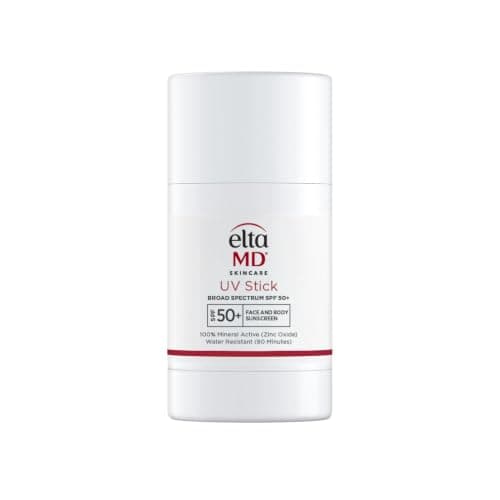
EltaMD UV Stick Broad Spectrum SPF 50+
EltaMD · Read our EltaMD review
22% transparent zinc at SPF 50+ with 80 minutes of water resistance in a solid stick — the strongest label claims you can realistically carry through a checkpoint.
- Actives:
- 22% transparent zinc oxide
- SPF:
- SPF 50+
- Water resistance:
- 80 minutes
- Reef status:
- Zinc only — no oxybenzone, octinoxate or octocrylene
- Best for:
- Real SPF 50+ protection without the liquids limit
What works
- Solid format
- SPF 50+ with 80-minute water resistance
- Cannot leak in a bag
The trade-off
- Slow over large areas
- Small for the price
#ad We earn from qualifying purchases · Price as of October 11, 2026
02 · Best for a child's day bag
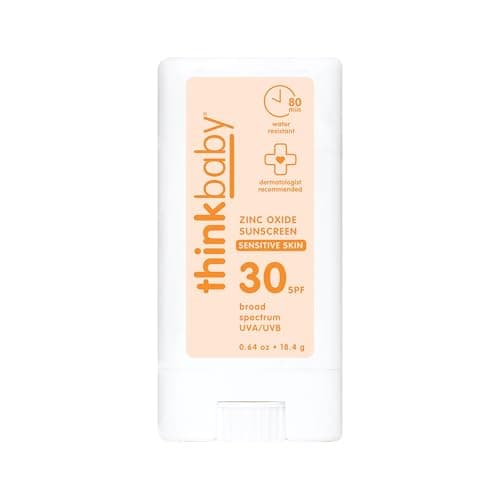
Thinkbaby Safe Sunscreen Stick SPF 30
Thinkbaby · Read our Thinkbaby review
Non-nano zinc oxide at SPF 30 with 80 minutes of water resistance in a stick — nothing to leak, nothing to sting, and small enough to live in a pocket.
- Actives:
- Non-nano zinc oxide
- SPF:
- SPF 30
- Water resistance:
- 80 minutes
- Reef status:
- Zinc only
- Best for:
- Reapplying on children away from the room
What works
- Zinc-only actives
- 80-minute water resistance
- Does not sting eyes
The trade-off
- SPF 30 rather than 50
- Visible white film
#ad We earn from qualifying purchases · Price as of October 11, 2026
03 · Best for the checked bag
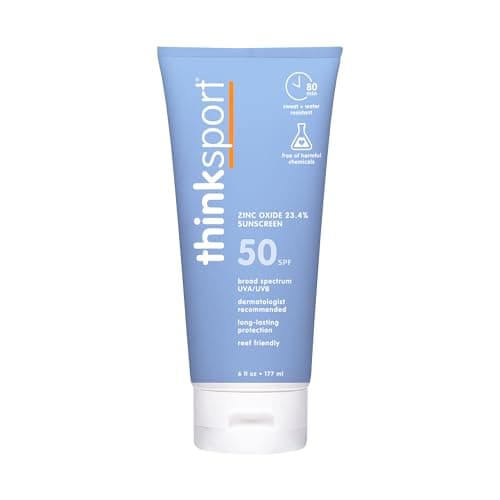
Thinksport Sunscreen SPF 50+
Thinksport · Read our Thinksport review
20% non-nano zinc at SPF 50+ with 80 minutes of water resistance in a large tube — the bottle that does the actual protecting, packed where the size limit is generous.
- Actives:
- 20% non-nano zinc oxide
- SPF:
- SPF 50+
- Water resistance:
- 80 minutes
- Reef status:
- Zinc only — no oxybenzone, octinoxate or octocrylene
- Best for:
- The full-dose application you do before leaving the room
What works
- SPF 50+ with maximum water resistance
- Large size for a whole trip
- Compliant with every reef restriction
The trade-off
- Too large for a carry-on
- Visible cast
#ad We earn from qualifying purchases · Price as of October 11, 2026
What else to know before you fly
- Buying at the destination is the expensive fallback. Airport and resort pricing on sunscreen is steep, and the selection is often limited to chemical formulas.
- Check whether your destination restricts filters. Hawaii, Key West, Aruba, Bonaire and Palau restrict particular chemical filters, and a mineral formula travels everywhere without a question. Where reef-safe sunscreen is required.
- Heat in a checked bag is not a problem for a sealed bottle, but an opened one can leak with pressure changes. Bag it.
- Sunscreen expires. Check the date before you pack last year's bottle, because the back of a hot car is the worst possible storage. Does sunscreen expire?
- Flying is also exposure. UV at altitude through a cabin window is higher than at ground level, which is a real argument for the stick in your bag.
Sources
- What Can I Bring? Sunscreen — U.S. Transportation Security Administration
- Questions and Answers: FDA Requirements for Over-the-Counter Sunscreen Products — U.S. Food and Drug Administration
- Sunscreen: How to Help Protect Your Skin from the Sun — U.S. Food and Drug Administration
- Sunscreen FAQs — American Academy of Dermatology
Frequently asked questions
Can you bring sunscreen on a plane in a carry-on?
Yes, at 3.4 ounces (100 ml) or less per container, inside your quart-sized liquids bag. Larger bottles have to go in checked baggage.
How much sunscreen can you put in a checked bag?
Per TSA's entry, the total for this class of product must not exceed 2 kg (70 ounces) or 2 L (68 fluid ounces) per passenger, and no single container may exceed 0.5 kg (18 ounces) or 500 ml (17 fluid ounces).
Is sunscreen considered a liquid by TSA?
For carry-on purposes, yes — the 3.4-ounce liquids limit applies. A solid sunscreen stick is not a liquid, gel or aerosol, though TSA states that the officer at the checkpoint makes the final call on any item.
Can you take aerosol sunscreen on a plane?
In checked baggage, yes, within the FAA limits, and TSA requires that the nozzle be protected by a cap or other means to prevent accidental release. In a carry-on it is still bound by the 3.4-ounce limit.
Should I buy sunscreen at my destination instead?
You can, but airport and resort pricing is high and the selection often skews chemical — which matters if you are going somewhere that restricts particular filters. Packing a checked bottle plus a carry-on stick is cheaper and more certain.
Read next
Sun Safety
The best sunscreen sticks
The sunscreen sticks worth buying, what their actives panels say, and the number of passes it takes to reach the SPF on the tube.
Sun Safety
Does sunscreen expire?
How long sunscreen lasts, what heat does to it, and the signs a bottle should be thrown out.
Reef-Safe & Ingredients
Where reef-safe sunscreen is actually required
Destination-by-destination restrictions, what each one covers, and what to pack.
Sun Safety
The best spray sunscreens
The spray sunscreens worth buying, what their labels actually say, and the technique that decides whether a can protects anything.

Sun Safety
How much sunscreen to apply
The measures by body area, and why under-application costs more protection than it seems.