Sun Safety
Do you need sunscreen on a cloudy day?
Cloud takes away the heat that would have told you to go inside.
Disclosure: Spf & Shore earns commission from qualifying purchases made through links on this page, at no extra cost to you. It does not change which products we recommend. Read the full disclosure.
Yes — on most cloudy days you still need sunscreen. UV passes through cloud far more readily than the visible light and infrared heat that make a day feel sunny, so an overcast sky removes the two cues your body uses to judge sun exposure while leaving a large share of the UV behind. The classic bad sunburn is not a beach-at-noon burn; it is a long gray afternoon outdoors with no sunscreen on.
The useful way to hold this is that cloud is a thermostat, not a sunscreen. It cuts the sensation of sun hard and the UV much less, which is why the day you did not think needed protection is often the day you got pink. The decision rule at the bottom of this page is three lines long.
Why cloud filters heat better than UV
Clouds are water droplets and ice crystals, and how much of a given wavelength they stop depends on the wavelength. Infrared — the part you feel as warmth — is absorbed and scattered strongly. Visible light is reduced enough to change the brightness of the day noticeably. Ultraviolet, with its much shorter wavelengths, is scattered rather than absorbed, and scattered UV is still UV: it arrives at your skin from all over the sky rather than from one direction.
That is the mechanism behind the most counter-intuitive fact here. Under a sky of bright broken cloud, UV at ground level can approach — and in some conditions briefly exceed — what you would get under a clear sky, because you are receiving direct sun through the gaps plus UV scattered off the bright cloud edges. A thick, uniform, dark overcast genuinely does cut UV substantially. A patchy white sky barely does.
What that means for the UV Index
The forecast UV Index is calculated for clear conditions, so a cloudy day's actual number is usually somewhat lower than the forecast — but not proportionally to how gray it looks. A forecast of 8 does not become a 2 because the sun went behind cloud, and treating it as though it does is the error this page exists to correct.
The EPA's thresholds still apply on a gray day: protection is called for from an index of 3 upward. What UV index means for sunscreen covers the whole scale and the shadow rule, which is also the fastest cloudy-day test available — if you can see a shadow at all, there is direct sun reaching you.
Where overcast burns actually happen
- On the water. An overcast boat day or paddle is the single most common version of this burn: cloud removes the heat, water reflects UV upward, and nobody feels hot enough to reapply.
- On snow. Fresh snow is a strong reflector and high-altitude cloud is thin. A flat-light ski day burns faces, chins and under-noses in a way a sunny beach rarely does.
- On long gray walks and gardening afternoons. Duration does the damage. A UV Index of 4 for five hours is a bigger dose than a 9 for twenty minutes.
- At a kids' sports game. Hours on an open field, no shade, no heat cue, and nobody packed sunscreen because it looked like rain.
- On a plane-to-pool travel day, where the sky changes three times and the sunscreen decision got made at breakfast.
The pattern in all five is the same: long exposure, no heat cue, and often reflection. None of them is about intensity at a single moment.
What to wear on a gray day
A cloudy day usually calls for a lighter routine rather than a different one — the daily face sunscreen you would wear anyway, carried forward. The exception is any gray day on water, snow or an open field for hours, which should be treated like a sunny day and not like a gray one.
Our picks in detail
01 · Best everyday face layer
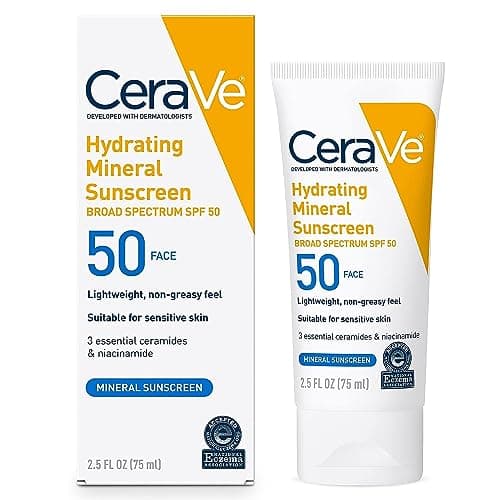
CeraVe Hydrating Mineral Sunscreen SPF 50 Face
CeraVe · Read our CeraVe review
Zinc oxide and titanium dioxide at SPF 50 with ceramides and hyaluronic acid, in a fragrance-free face formula at drugstore pricing. The best argument for a daily layer is that you stop making a weather decision every morning.
- Actives:
- Zinc oxide and titanium dioxide, with ceramides and hyaluronic acid
- SPF:
- SPF 50
- Water resistance:
- 40 minutes
- Reef status:
- Mineral filters only
- Best for:
- The gray-week habit that does not need thinking about
What works
- Mineral filters in a hydrating, fragrance-free base
- Cheap and stocked almost everywhere
- Pleasant enough to wear on a day you do not think you need it
The trade-off
- 40 minutes of water resistance, not 80
- Leaves some cast on deeper skin tones
- Face-size tube, so it is not a body product
#ad We earn from qualifying purchases · Price as of November 2, 2026
02 · Best for a daily routine under makeup
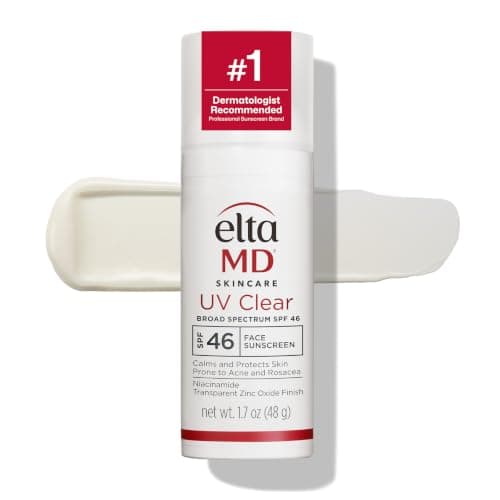
EltaMD UV Clear Broad-Spectrum SPF 46
EltaMD · Read our EltaMD review
A very light SPF 46 that EltaMD lists with 9% zinc oxide and 5% niacinamide. The trade is real and we name it: it contains octinoxate, which Hawaii and Key West restrict, so this is a city product rather than a reef one.
- Actives:
- Zinc oxide with octinoxate; EltaMD lists 9% zinc oxide and 5% niacinamide
- SPF:
- SPF 46
- Water resistance:
- Not labeled water resistant
- Reef status:
- Contains octinoxate, which Hawaii and Key West restrict
- Best for:
- Wearing SPF through a gray workweek without noticing it
What works
- Light enough for daily wear on oily and acne-prone skin
- Niacinamide alongside the zinc
- Sits invisibly under makeup
The trade-off
- Contains octinoxate — not a reef-restricted-destination choice
- Not labeled water resistant
- Expensive for a daily-wear bottle
#ad We earn from qualifying purchases · Price as of November 2, 2026
03 · Best to carry on a changeable day
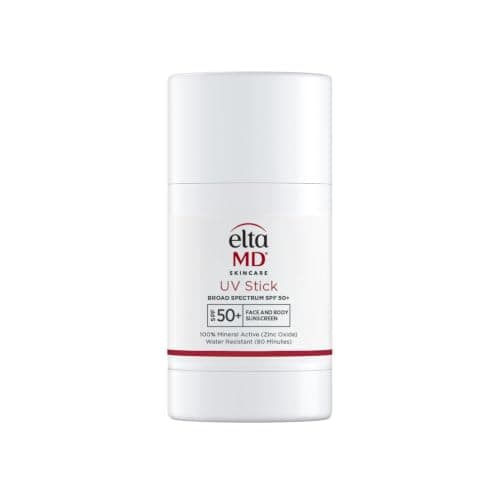
EltaMD UV Stick Broad Spectrum SPF 50+
EltaMD · Read our EltaMD review
22% transparent zinc at SPF 50+ and 80 minutes of water resistance in a pocket-size solid. The right answer to an uncertain sky is a product you can put on at the moment the cloud breaks.
- Actives:
- 22% transparent zinc oxide
- SPF:
- SPF 50+
- Water resistance:
- 80 minutes
- Reef status:
- Zinc only — no oxybenzone, octinoxate or octocrylene
- Best for:
- The gray morning that turns bright by noon
What works
- Pocketable, so it is there when the sky changes
- Zinc-only actives at the maximum water-resistance claim
- Clear enough to use on a face in public
The trade-off
- Thin film — four passes over the same patch
- Dermatology-counter pricing
- Softens out of shape in a hot car
#ad We earn from qualifying purchases · Price as of November 2, 2026
Rain, fog and the genuinely low days
We should be honest about the other side. There are real days when sunscreen is not doing much: heavy continuous rain under a thick dark overcast, dense fog in winter at a high latitude, and short errands rather than hours outdoors. The EPA's own scale says no protection is needed at an index of 1 to 2, and a mid-winter northern overcast often sits there.
What makes those days safe is the combination of low sun angle, thick uniform cloud and short exposure — not the grayness alone. Change any one of the three, particularly duration, and the answer changes. If you already wear a daily face sunscreen, there is also no reason to interrupt the habit for a gray week; the cost is zero and the routine is the thing that works.
The three-line rule
- Can you see your shadow? Then there is direct sun on you, and you should be wearing sunscreen regardless of how the sky looks.
- Will you be out for more than an hour, or near water or snow? Then wear it whether or not you can see a shadow — duration and reflection are what cause overcast burns.
- Thick dark overcast, under an hour, no water, no snow? You can skip it without guilt. Everything else, wear it.
That is the whole decision. If you want the mechanism behind why a thin film still works on a scattered-UV day, how sunscreen works covers it, and do you need sunscreen indoors covers the related question about glass.
One myth worth retiring
You sometimes read that cloud blocks a specific, confident percentage of UV. The number quoted is rarely sourced and it varies enormously with cloud type, thickness, sun angle and how much of the sky is covered — which is why we have not put a figure on this page. The direction of the effect is well established; the magnitude on your particular gray afternoon is not something any page can tell you.
If you want a number for your day rather than an average, the UV Index forecast is the right tool, and the shadow is the right field check when you do not have a forecast. Both beat judging a sky by how bright it looks.
Sources
- UV Index Scale — U.S. Environmental Protection Agency
- Learn About the UV Index — U.S. Environmental Protection Agency
- Sun Safety — Centers for Disease Control and Prevention
- Sunburn — Skin Cancer Foundation
- How to prevent skin cancer — American Academy of Dermatology
Frequently asked questions
Do you need sunscreen on a cloudy day?
On most cloudy days, yes. UV passes through cloud much more readily than the heat and visible light that make a day feel sunny, so an overcast sky removes your cues while leaving a large share of the UV. Long gray afternoons outdoors are a common cause of unexpected sunburn.
Can you get sunburned when it is cloudy?
Yes, and it is one of the more frequent ways people burn badly, because nothing about the day prompts them to reapply or seek shade. Bright broken cloud is the worst case: direct sun through the gaps plus UV scattered off bright cloud edges.
How much UV gets through clouds?
It varies far too much with cloud type, thickness, coverage and sun angle for any single percentage to be meaningful, which is why we do not quote one. A thick uniform dark overcast cuts UV substantially; a thin or broken white sky cuts it very little.
Do you need sunscreen when it is raining?
Heavy continuous rain under thick dark cloud, for a short time, is one of the genuinely low-UV situations. If you will be out for hours, or near water or snow, wear it anyway — duration and reflection matter more than the sky.
Does the UV index account for clouds?
The forecast index is calculated for clear conditions, so a cloudy day's real value is usually somewhat lower. It does not fall anywhere near proportionally to how gray the sky looks, and the EPA's threshold of 3 for protection still applies.
Read next
Sun Safety
What UV index do you need sunscreen?
The EPA's UV Index thresholds, what each band actually asks you to do, the shadow rule for when you have no forecast, and why the number alone is not the whole decision.
Sun Safety
How sunscreen works
The mechanism behind UV filters, the UVA and UVB difference, and why the amount applied matters so much.

Face & Tinted SPF
Do you need sunscreen indoors?
Window glass blocks UVB but passes UVA, so indoor sunscreen is about photoaging and pigmentation rather than burning. When it is worth it.
Sun Safety
Sun poisoning vs sunburn
How to tell severe sunburn from ordinary, the warning signs, and when to call a clinician.
Sun Safety
The best sunscreens
One pick per situation — face, body, kids, water, sensitive skin — chosen on the label, not the packaging.
Sun Safety
How long does sunscreen last on skin?
Why the two-hour rule exists, what actually removes a sunscreen film, and how long a layer really lasts indoors or on a still day with no sweat and no water.