Sun Safety
How long does sunscreen last on skin?
Two hours is the label answer. What ends a film is almost never the clock.
Disclosure: Spf & Shore earns commission from qualifying purchases made through links on this page, at no extra cost to you. It does not change which products we recommend. Read the full disclosure.
Assume two hours in the sun, and less than that any time water, sweat, sand or a towel is involved. That is the number every US sunscreen label carries, and it is the right working answer. But it is a reapplication instruction rather than a measurement of how long the film survives — and on a still day indoors, a sunscreen layer can be substantially intact for much longer than two hours.
The distinction matters because the two situations fail for different reasons. In sun and sweat, the film is physically removed. Out of the sun, the film mostly just sits there. What follows is what actually ends a layer of sunscreen, in rough order of how much damage each one does.
Where the two-hour rule comes from
The FDA requires sunscreen labels to tell you to reapply at least every two hours, and the American Academy of Dermatology repeats it. It is not the result of a study showing that films expire at the 120-minute mark. It is a conservative interval chosen to cover the realistic worst case: a person outdoors, moving, sweating, touching their face, who applied less product than the test dose to begin with.
That last clause is the one that does the work. Every SPF number is established at 2 milligrams of product per square centimeter of skin. Most people apply something closer to a quarter to a half of that, which means the film starts thin — and a thin film has less margin to lose before protection drops off meaningfully. How much sunscreen to apply has the arithmetic, and it is the single most useful thing to fix before worrying about timing.
What actually removes a sunscreen film
Five mechanisms, and only one of them has anything to do with time passing.
- Toweling. The fastest and most complete removal there is. A single brisk towel-dry takes off most of what is on the skin it touches, which is why the water-resistance test explicitly forbids toweling between immersions.
- Friction. A shirt collar, a pack strap, a waistband, a car seat, a hand resting on a cheek. Any repeated contact moves product off and usually onto something else.
- Sweat. Water emerging from underneath the film, which emulsifies it and carries it downhill. This is why a forehead loses product faster than a shoulder under a shirt does.
- Water immersion. Less destructive than toweling, and the only one of the five that a US label actually quantifies — at 40 or 80 minutes. What water-resistant sunscreen actually means covers the test.
- Filter breakdown under UV. Real, and the slowest of the five. Some filters degrade as they absorb UV; zinc oxide and titanium dioxide are among the more photostable options, which is part of the case for mineral formulas.
Put plainly: on a beach day the film is gone long before the filters are. On a desk-bound day in indirect light, the filters outlast your interest in the question.
What to reapply with, by situation
The product that gets reapplied is the one that is physically with you and does not require starting over. That is the whole criterion, and it is why the picks below are formats as much as formulas.
Our picks in detail
01 · Easiest to reapply
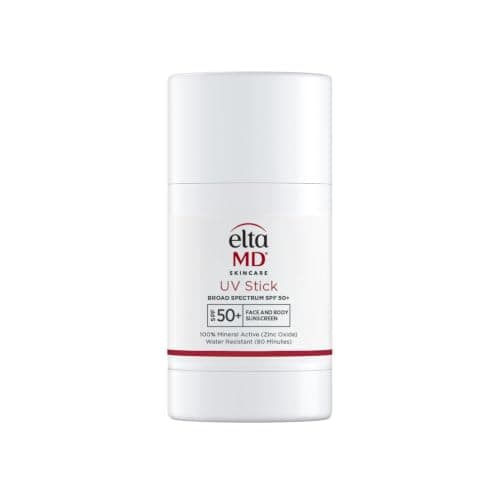
EltaMD UV Stick Broad Spectrum SPF 50+
EltaMD · Read our EltaMD review
22% transparent zinc at SPF 50+ with 80 minutes of water resistance. A stick is the only format most people will genuinely reapply at hour two, which makes it the best-performing product on this page in practice.
- Actives:
- 22% transparent zinc oxide
- SPF:
- SPF 50+
- Water resistance:
- 80 minutes
- Reef status:
- Zinc only — no oxybenzone, octinoxate or octocrylene
- Best for:
- Faces, mid-day, with no mirror and no mess
What works
- Reapplies over existing sunscreen without a reset
- Zinc-only actives at the maximum US water-resistance claim
- Pocketable, so the second application actually happens
The trade-off
- Thin film — four passes, not one
- Dermatology-counter pricing
- Softens out of shape in a hot car
#ad We earn from qualifying purchases · Price as of November 2, 2026
02 · Fastest reapplication on a body
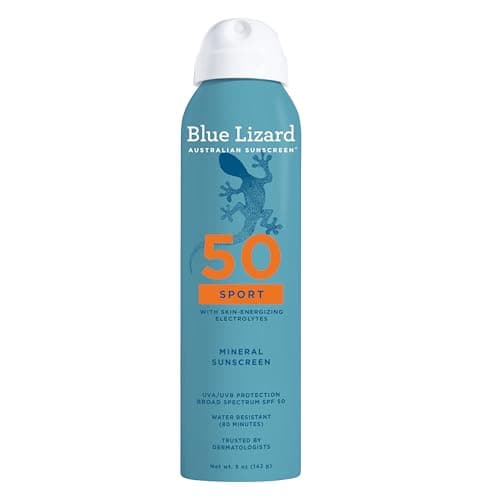
Blue Lizard Sport Mineral Sunscreen Spray SPF 50+
Blue Lizard · Read our Blue Lizard review
24% zinc oxide as the sole filter, SPF 50+, 80 minutes of water resistance. The speed is the point: a reapplication you can finish in a minute is one you will do.
- Actives:
- 24% zinc oxide as the sole active filter
- SPF:
- SPF 50+
- Water resistance:
- 80 minutes
- Reef status:
- Zinc only — no oxybenzone or octinoxate
- Best for:
- Re-covering legs, arms and backs between swims
What works
- Covers a lot of skin quickly
- Zinc-only at a high concentration
- 80-minute water-resistance claim
The trade-off
- Has to be rubbed in or the coverage is striped
- Wind wastes a real share of each pass
- Harder to judge whether you applied enough
#ad We earn from qualifying purchases · Price as of November 2, 2026
03 · Best for applying a real dose
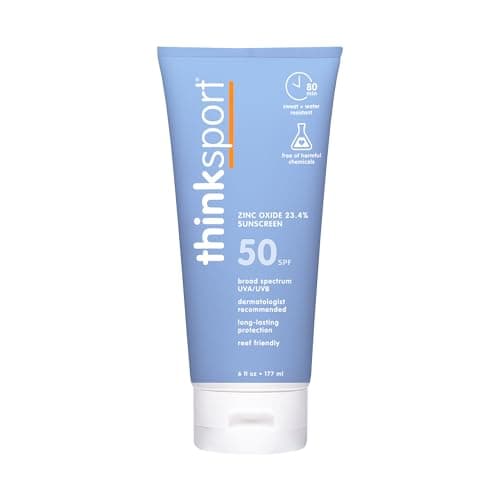
Thinksport Sunscreen SPF 50+
Thinksport · Read our Thinksport review
20% non-nano zinc at SPF 50+ and 80 minutes of water resistance, in tubes large enough that an honest ounce of product does not feel wasteful. Dose beats schedule, and this is the dose bottle.
- Actives:
- 20% non-nano zinc oxide
- SPF:
- SPF 50+
- Water resistance:
- 80 minutes
- Reef status:
- Zinc only — no oxybenzone, octinoxate or octocrylene
- Best for:
- The first application, which is the one that matters most
What works
- Large sizes make the tested dose realistic
- High non-nano zinc, no fragrance
- Maximum water-resistance claim a US label may make
The trade-off
- Thick and slow to spread
- Visible cast on deeper skin tones
- Too slow for a mid-afternoon touch-up
#ad We earn from qualifying purchases · Price as of November 2, 2026
How long it lasts indoors, and whether you need to reapply
A morning application of a face sunscreen, on someone who then sits inside near a window, is largely still there at lunch. Nothing has toweled it, no sweat has emulsified it, and the UV load through ordinary window glass is a fraction of what it would be outside. Reapplying at noon in that scenario is reasonable belt-and-braces, not a requirement.
What does degrade an indoor layer is touching your face, a mask or collar rubbing, and anything you put on over it. If you blot shine with a tissue at 2pm, you have removed sunscreen from the areas you blotted. Do you need sunscreen indoors answers the broader question about glass and UVA, and how often to reapply mineral sunscreen covers the specific mineral-film version.
| Situation | What ends it | Working interval |
|---|---|---|
| Beach or pool | Water, then toweling | Reapply after every exit from the water |
| Running or field sport | Sweat, wiping, fabric | Reapply at ninety minutes, sooner on the face |
| Walking or gardening | Sweat and incidental friction | Two hours |
| Driving | Friction on the arm, UVA through glass | Two hours on exposed skin |
| Indoors near a window | Touching, blotting, layering over it | Once in the morning is usually enough |
Does the time in the bottle change the time on your skin?
Yes, at the margins. A sunscreen that has been through a hot summer in a car has had its formulation stressed — separation, thinning and filter degradation all accelerate with heat — and a stressed formula lays down a less even film. Does sunscreen expire covers the shelf question, and sunscreen in a hot car covers the specific case.
Within the normal life of a bottle stored indoors, though, this is not the variable that matters. Dose and removal are. A fresh bottle applied thinly protects worse than a two-year-old bottle applied properly.
The practical version
- Apply fifteen minutes before exposure, so the film can set. The water-resistance test includes a waiting period for exactly this reason.
- Reapply on exit from water, every time, and do not towel first if you can avoid it. Pat rather than rub.
- Reapply every two hours outdoors regardless of how intact it looks. A mineral film going invisible is not evidence that it is gone, and a film that still looks white is not evidence that it is working.
- Fix the dose before you fix the schedule. Doubling how much you apply buys more real-world protection than halving the interval does.
- Add something that does not come off. A UPF shirt and a brim do not need reapplying at all. How UPF clothing works explains the rating.
What this page is not claiming
Nobody can give you a verified minute count for your skin, your product and your day — SPF testing measures the dose at which a film prevents visible redness in a lab, not how long a film survives a barbecue. Every interval above is a working rule derived from the removal mechanism, not a measurement, and we have labeled it that way deliberately.
If a page tells you a specific sunscreen lasts a specific number of minutes on skin outside the 40- and 80-minute water-resistance claims, it is extrapolating. The honest answer is the one on the bottle, adjusted down for whatever you are about to do.
Sources
- Sunscreen: How to Help Protect Your Skin from the Sun — U.S. Food and Drug Administration
- 21 CFR 201.327 — Over-the-counter sunscreen drug products; required labeling — Legal Information Institute, Cornell Law School
- Sunscreen FAQs — American Academy of Dermatology
- Sunscreen — Skin Cancer Foundation
- Questions and Answers: FDA Requirements for Over-the-Counter Sunscreen Products — U.S. Food and Drug Administration
Frequently asked questions
How long does sunscreen last on your skin?
Assume two hours outdoors, and less whenever water, sweat, sand or a towel is involved. The two-hour figure is the FDA's reapplication instruction rather than a measured expiry — what ends a film is almost always physical removal, not time.
How long does sunscreen last on skin if you are not in the sun?
Longer. With no sweat, no water and no toweling, a morning layer is largely intact hours later. What removes it indoors is touching your face, blotting shine and layering products over it.
Do you need to reapply sunscreen if you stay inside?
Usually not for UV reasons alone. One morning application is reasonable for a day spent indoors; reapply if you go out, if you have blotted or washed your face, or if you are sitting in direct sun through glass for long stretches.
Does sunscreen stop working after two hours?
No. It degrades gradually and unevenly, and the main cause is removal rather than chemistry. The two-hour rule exists because most people apply far less than the tested dose, which leaves little margin for the film to lose.
Is mineral sunscreen longer-lasting than chemical sunscreen?
Zinc oxide and titanium dioxide are among the more photostable filters, so they hold up better against UV-driven breakdown. They are no more resistant to being toweled, rubbed or sweated off, which is what actually ends most films.
Read next

Sun Safety
How much sunscreen to apply
The measures by body area, and why under-application costs more protection than it seems.
Mineral Sunscreen
How often should you reapply mineral sunscreen?
Why mineral sunscreen needs reapplying every two hours like any other, where the longer-lasting myth comes from, and what actually removes the film.
Sun Safety
What water-resistant sunscreen actually means
What the 40 and 80-minute claims measure, why toweling ends them, and how to plan a pool day around it.
Sun Safety
Does sunscreen expire?
How long sunscreen lasts, what heat does to it, and the signs a bottle should be thrown out.
Sun Safety
How SPF is tested and set
The FDA's SPF test in plain English: human volunteers, a solar simulator, 2 mg per square centimeter, and the separate tests behind broad spectrum and water resistance.

Face & Tinted SPF
Do you need sunscreen indoors?
Window glass blocks UVB but passes UVA, so indoor sunscreen is about photoaging and pigmentation rather than burning. When it is worth it.