Sun Safety
How SPF is tested and set
Ten volunteers, a solar simulator, and a dose nobody applies at home.
Disclosure: Spf & Shore earns commission from qualifying purchases made through links on this page, at no extra cost to you. It does not change which products we recommend. Read the full disclosure.
SPF is measured on human volunteers, not in a machine. Testers apply the sunscreen at 2 milligrams per square centimeter of skin, wait at least fifteen minutes, expose marked patches of protected and unprotected skin to graded doses of UV from a solar simulator, and read the results the next day. SPF is the ratio of the UV dose that just barely reddens protected skin to the dose that just barely reddens bare skin.
Two consequences follow, and they explain most of what confuses people about sunscreen labels. First, the number is a ratio of doses, not a span of time. Second, the dose used in the test is roughly double to quadruple what people apply in real life, which is why a bottle of SPF 50 does not behave like SPF 50 on an actual shoulder.
The test, step by step
The procedure is written into US regulation at 21 CFR 201.327(i), which means it is not a brand's internal method — it is a prescribed one. The outline is short enough to read in a minute.
- Recruit the panel. The test needs enough volunteers to produce at least ten valid results, screened by medical history and limited to the more sun-sensitive skin types — those who always or moderately burn.
- Mark the sites. Each test site on the back is at least 30 square centimeters, outlined in indelible ink, with at least five smaller subsites inside it that will each receive a different UV dose.
- Apply at 2 mg/cm-squared. The sunscreen and a reference standard go on at exactly that rate, spread with a finger cot as evenly as possible.
- Wait at least fifteen minutes before any UV exposure, so the film can set.
- Expose to a solar simulator filtered to emit a continuous spectrum from 290 to 400 nanometers, with specified proportions of UVB, UVA II and UVA I.
- Read the minimal erythema dose. The MED is the smallest UV dose that produces perceptible redness. SPF is the protected MED divided by the unprotected MED.
That is the whole thing. No skin cancer endpoint, no tanning endpoint, no measurement of how long the product survives a towel. The test measures one outcome — the dose at which skin visibly reddens — because redness is the response that can be read reliably on a human volunteer in a day.
Why SPF is a dose ratio and not a clock
If bare skin reddens after a particular dose of UV and protected skin needs thirty times that dose, the SPF is 30. People translate that into time — thirty times longer before burning — and the translation holds only if UV intensity is constant, which it never is. UV peaks around solar noon and drops off at the edges of the day, so an hour at 1pm and an hour at 6pm are not the same dose.
The more useful way to read the number is as a fraction of UV that gets through. SPF 30 blocks about 97% of the UVB that drives erythema; SPF 50 blocks about 98%. Those are close together, which is the whole substance of the SPF 30 versus SPF 50 argument — and the reason applying enough matters more than climbing the number.
Broad spectrum is a completely separate test
SPF only describes the sunburn-driving part of the spectrum. The broad-spectrum claim comes from a different procedure in the same regulation, and it is not done on people at all. The product is spread on a roughened plastic plate at 0.75 milligrams per square centimeter, pre-irradiated to account for filters that break down, and then read in a spectrometer across the whole UV range.
The output is a single figure called the critical wavelength — the point at which the absorbance curve has accumulated 90% of its total across 290 to 400 nanometers. A mean critical wavelength of 370 nanometers or greater earns the broad-spectrum claim. It is a pass or fail, not a scale, which is why no bottle can advertise being more broad spectrum than another. What broad spectrum means covers what that does and does not promise about UVA.
And water resistance is a third test
A US sunscreen may claim water resistance for 40 minutes or 80 minutes, and nothing else. The procedure alternates timed immersion in water with timed rest periods out of it — a fixed sequence of moderate activity in water, rest without toweling, more activity in water, then drying without toweling — before the SPF reading is taken.
Two things fall out of that. The no-toweling rule is in the regulation because toweling removes product, which is the single best argument for patting dry instead of rubbing. And there is no sweat in the test at all, which is why a sport label is a claim about water rather than about a hot run. What water-resistant sunscreen actually means goes through it in detail.
What to buy, read through the tests
Once you know there are three separate tests, a label reads differently: SPF, broad spectrum and a water-resistance claim are three independent pieces of information, and a product can have any combination of them. The three picks below are the same three mineral formulas seen through that lens — one with every claim, one with a short water-resistance claim, and one with none at all.
Our picks in detail
01 · Every claim on the panel
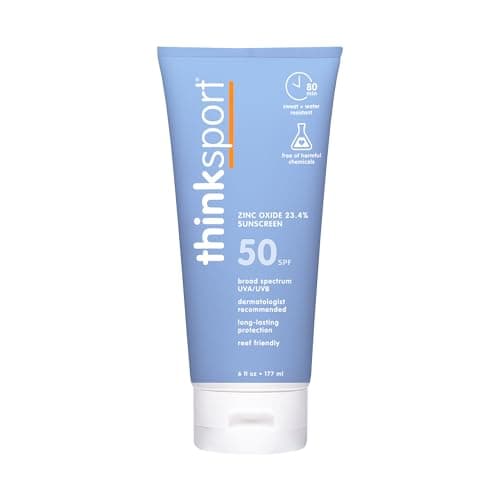
Thinksport Sunscreen SPF 50+
Thinksport · Read our Thinksport review
SPF 50+, broad spectrum, and 80 minutes of water resistance — the maximum of all three claims a US sunscreen label can carry, on 20% non-nano zinc oxide.
- Actives:
- 20% non-nano zinc oxide
- SPF:
- SPF 50+
- Water resistance:
- 80 minutes
- Reef status:
- Zinc only — no oxybenzone, octinoxate or octocrylene
- Best for:
- Seeing what a full set of label claims looks like
What works
- All three tests passed at the top of their range
- High non-nano zinc with no fragrance
- Large sizes make the tested dose affordable
The trade-off
- Thick and slow to spread
- Visible cast on deeper skin tones
- Not a face-elegant formula
#ad We earn from qualifying purchases · Price as of November 2, 2026
02 · The shorter water-resistance claim
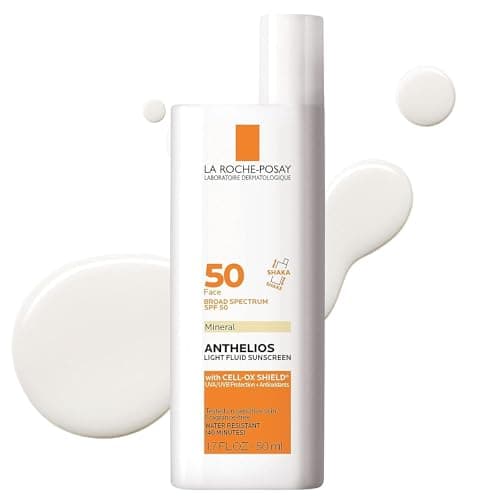
La Roche-Posay Anthelios Mineral SPF 50 Face Sunscreen
La Roche-Posay
SPF 50 and broad spectrum, with a 40-minute water-resistance claim rather than 80. That is a labeling fact, not a defect — it is a daily-wear product tested as one.
- Actives:
- Titanium dioxide with antioxidants
- SPF:
- SPF 50
- Water resistance:
- 40 minutes
- Reef status:
- Mineral filters only
- Best for:
- A daily face layer rather than a water day
What works
- Even, rub-in face coverage
- Widely available on US pharmacy shelves
- Antioxidants alongside the titanium dioxide filter
The trade-off
- 40 minutes of water resistance, not 80
- Titanium-led rather than a zinc formula
- Not the pick for a pool day
#ad We earn from qualifying purchases · Price as of November 2, 2026
03 · No water-resistance claim at all
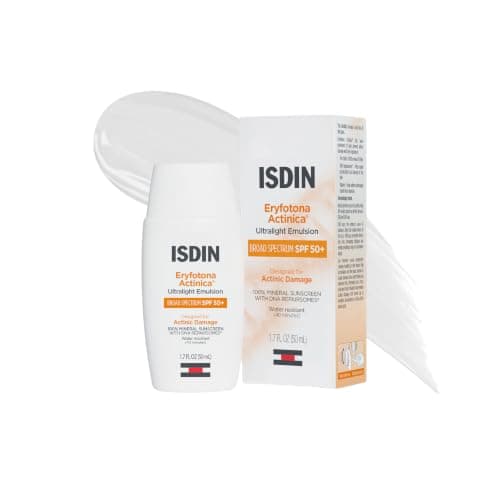
ISDIN Eryfotona Actinica Mineral Sunscreen SPF 50+
ISDIN
SPF 50+ zinc-only, with no water-resistance claim on the panel. An absent claim is not a weaker claim — it is an untested one, and the label will tell you to use something else if you are swimming or sweating.
- Actives:
- Zinc oxide as the sole active filter
- SPF:
- SPF 50+
- Water resistance:
- Not labeled water resistant
- Reef status:
- Zinc only
- Best for:
- Understanding what an absent claim means
What works
- Zinc oxide as the sole active filter
- Very light finish for a high-SPF mineral
- Short, fragrance-free panel
The trade-off
- No water-resistance claim — wrong product for water or sweat
- Expensive per ounce
- Sold mainly through dermatology and specialty channels
#ad We earn from qualifying purchases · Price as of November 2, 2026
What the number cannot tell you
- How much UVA protection you are getting, beyond pass or fail. The critical wavelength threshold is one bar at 370 nm. Two broad-spectrum products can differ meaningfully in UVA coverage and label identically.
- Whether it will survive your day. Nothing in the SPF test simulates sweat, sand, fabric or a towel. How long sunscreen lasts on skin covers removal.
- Whether you will apply enough. The test dose is 2 mg/cm-squared. Real-world application is commonly a fraction of that, which drops effective protection well below the labeled number. How much sunscreen to apply has the fix.
- Anything about pigmentation or visible light. Erythema is the endpoint, so the test is silent on melasma and on visible-light-driven pigmentation. Iron oxides and visible light is the relevant page.
- Whether it suits your skin. Irritation, breakouts and stinging are not test endpoints at all.
Does sunscreen work, measured over years?
The SPF test is a short-term proxy, so the fair question is whether the proxy translates into outcomes. The best evidence comes from a randomized trial in Nambour, Queensland, where daily sunscreen use was assigned rather than self-selected: follow-up reported fewer squamous cell carcinomas, and a later follow-up reported reduced melanoma incidence in the daily-use group. A separate randomized trial reported less photoaging among daily users.
We cite those by name rather than restating them as our own finding, because that is the difference between reporting evidence and borrowing authority. What independent sunscreen testing actually finds covers the separate question of whether bottles deliver the SPF they claim when third parties retest them.
Sources
- 21 CFR 201.327 — Over-the-counter sunscreen drug products; required labeling — Legal Information Institute, Cornell Law School
- Questions and Answers: FDA Requirements for Over-the-Counter Sunscreen Products — U.S. Food and Drug Administration
- Sunscreen: How to Help Protect Your Skin from the Sun — U.S. Food and Drug Administration
- Daily sunscreen application and betacarotene supplementation in prevention of basal-cell and squamous-cell carcinomas of the skin: a randomized controlled trial — Green et al., The Lancet (1999)
- Reduced melanoma after regular sunscreen use: randomized trial follow-up — Green et al., Journal of Clinical Oncology (2011)
- Sunscreen and prevention of skin aging: a randomized trial — Hughes et al., Annals of Internal Medicine (2013)
Frequently asked questions
How is SPF tested?
On human volunteers. The sunscreen is applied at 2 milligrams per square centimeter to marked patches of skin, left at least fifteen minutes, then exposed to graded UV doses from a solar simulator. SPF is the ratio of the dose that just reddens protected skin to the dose that just reddens unprotected skin.
How many people are in an SPF test?
Enough volunteers to yield at least ten valid results, with a maximum of three subjects allowed to be rejected from the panel. Participants are screened by medical history and limited to the more sun-sensitive skin types.
Does SPF mean how long you can stay in the sun?
No. SPF is a ratio of UV doses, not a multiplier of minutes. UV intensity changes through the day and with altitude, latitude and reflection, so the same clock reading can be a very different dose.
How is broad spectrum tested?
In a spectrometer rather than on people. The product goes onto a roughened plastic plate at 0.75 milligrams per square centimeter, is pre-irradiated, and is read across 290 to 400 nanometers. A mean critical wavelength of 370 nanometers or more earns the claim.
Why does real-world SPF seem lower than the label?
Because the label number is established at a dose most people never apply. Applying a quarter of the test amount does not give you a quarter of the protection — it drops it substantially. Applying more product is the most effective change available.
Read next
Sun Safety
SPF 30 vs SPF 50
What the numbers actually mean, why the gap looks different depending on framing, and which to buy.
Mineral Sunscreen
What broad spectrum means on a sunscreen label
The regulated FDA claim behind the phrase, why SPF alone is not enough, and what UVA actually does.
Sun Safety
What water-resistant sunscreen actually means
What the 40 and 80-minute claims measure, why toweling ends them, and how to plan a pool day around it.

Sun Safety
How much sunscreen to apply
The measures by body area, and why under-application costs more protection than it seems.
Sun Safety
What independent sunscreen testing actually finds
The organizations that actually test sunscreen, what each one measures, and how to read a sunscreen review honestly.
Sun Safety
How long does sunscreen last on skin?
Why the two-hour rule exists, what actually removes a sunscreen film, and how long a layer really lasts indoors or on a still day with no sweat and no water.