Sun Safety
Can you leave sunscreen in a hot car?
It will not explode. It will quietly stop being the product on the label.
Disclosure: Spf & Shore earns commission from qualifying purchases made through links on this page, at no extra cost to you. It does not change which products we recommend. Read the full disclosure.
For an afternoon, it is fine. For a season, it is not. The FDA tells you to protect sunscreen from excessive heat and to avoid leaving it in a car on a hot day, and the reason is straightforward: heat accelerates both the chemical breakdown of the filters and the physical separation of the emulsion holding them. Neither failure makes the bottle look obviously bad, which is exactly the problem.
So the honest answer to the glovebox question is this. Heat is the main reason a sunscreen stops performing before its printed date, and a car in summer is the hottest place a bottle will ever live. Keep a bottle in the car for convenience if you want — just treat it as a single-season item and replace it rather than trusting it next year.
What heat actually does to the bottle
Two separate failures, with different symptoms.
- Filter degradation. Sunscreen actives are chemically active compounds, and higher temperatures speed up the reactions that break some of them down. A degraded filter is still in the bottle; it just absorbs less UV than the label was tested on. This failure is completely invisible.
- Emulsion separation. A sunscreen lotion is oil, water and solids held in suspension. Heat thins that suspension and lets the components drift apart, which is why a heat-stressed bottle can pour thin, watery or streaky. A separated product lays down an uneven film even if you apply plenty of it, and an uneven film protects unevenly.
There is a third, format-specific one: a wax stick in a hot car melts and re-sets, and the texture never fully returns. The stick that slumps into the cap and hardens into a new shape is not dangerous, but it will no longer lay down an even pass.
No, it will not explode. Yes, aerosols are different.
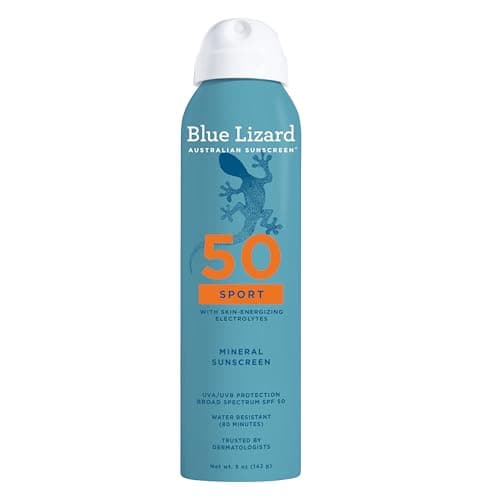
A plastic lotion bottle in a hot car does not burst. At worst it swells and weeps around the cap as the contents expand. An aerosol can is a genuinely different object: it holds pressurized propellant, and pressure rises with temperature, which is why aerosol cans themselves carry warnings about storing them above specified temperatures or in direct sun.
In practice, cans failing in parked cars is rare rather than routine — the cans are built with a margin. But it is the one format where the failure mode is physical rather than quiet, and it is a good enough reason to keep the spray in the house and the stick in the car. If you are flying with one, the cap rule matters too: can you bring sunscreen on a plane covers the aerosol requirements.
The signs that a bottle is done
- It pours thinner or more watery than it used to. The clearest sign of a broken emulsion.
- It has separated into layers, or needs vigorous shaking to look right. A mineral sunscreen settling a little is normal; a lotion that has split is not.
- The color or smell has changed. Both suggest oxidation somewhere in the formula.
- It is grainy, lumpy or stringy on the skin instead of spreading smoothly.
- The stick has melted and re-set, so it no longer has a flat face to apply with.
- It is past the printed expiration date, or it is more than three years old with no date on it. Does sunscreen expire covers the shelf-life rules.
Any one of those is enough to replace the bottle. The cost of being wrong is asymmetric: a new bottle is cheap, and a burn you thought you had prevented is not.
What to keep in the car instead
The case for keeping sunscreen in the car is real — the product you have with you beats the better product at home. The way to do it well is to pick formats that tolerate heat best, buy a size you will finish within a season, and store it in the least-hot place available.
Our picks in detail
01 · Best car bottle to replace each season
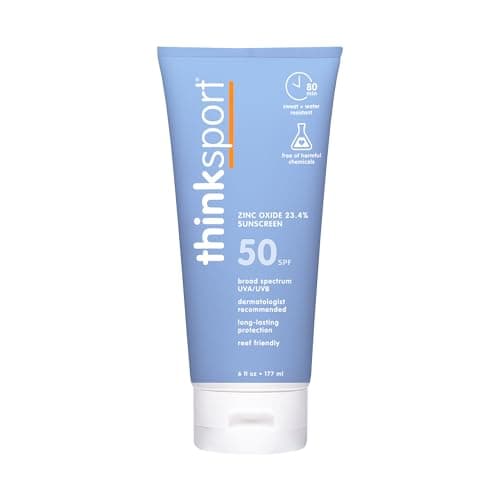
Thinksport Sunscreen SPF 50+
Thinksport · Read our Thinksport review
20% non-nano zinc at SPF 50+ with 80 minutes of water resistance. Zinc is among the more photostable filters, and the sizes are cheap enough that treating it as a single-season item is painless.
- Actives:
- 20% non-nano zinc oxide
- SPF:
- SPF 50+
- Water resistance:
- 80 minutes
- Reef status:
- Zinc only — no oxybenzone, octinoxate or octocrylene
- Best for:
- A bottle you will actually finish before it has time to degrade
What works
- Photostable mineral filter at a high concentration
- Maximum water-resistance claim a US label may carry
- Affordable enough to replace every season without flinching
The trade-off
- Thick, and a heat-thinned tube is harder to judge
- Visible cast on deeper skin tones
- The large sizes take a long time to finish
#ad We earn from qualifying purchases · Price as of November 2, 2026
02 · Best for a beach bag that lives in the trunk
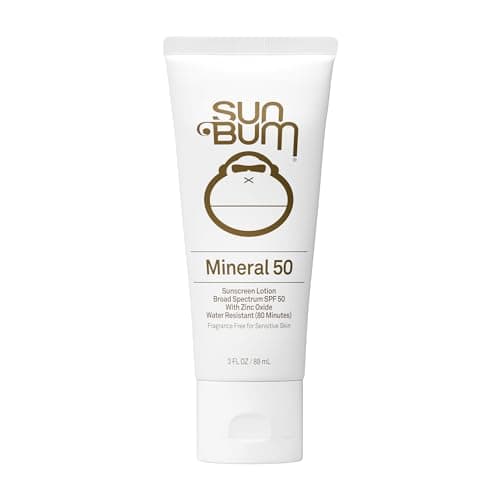
Sun Bum Mineral Sunscreen Lotion SPF 50
Sun Bum
Zinc oxide and titanium dioxide at SPF 50 with 80 minutes of water resistance, widely stocked enough that replacing it mid-season is a grocery-run decision rather than an online order.
- Actives:
- Zinc oxide and titanium dioxide
- SPF:
- SPF 50
- Water resistance:
- 80 minutes
- Reef status:
- Mineral filters only
- Best for:
- The bottle that goes car, sand, car, sand all summer
What works
- Mineral filters with the full 80-minute claim
- Available almost everywhere, so replacement is easy
- Spreads more easily than most zinc-heavy lotions
The trade-off
- Scented, which not everyone wants on a face
- Still leaves a cast
- Not a fragrance-free option for reactive skin
#ad We earn from qualifying purchases · Price as of November 2, 2026
03 · Best format for a glovebox
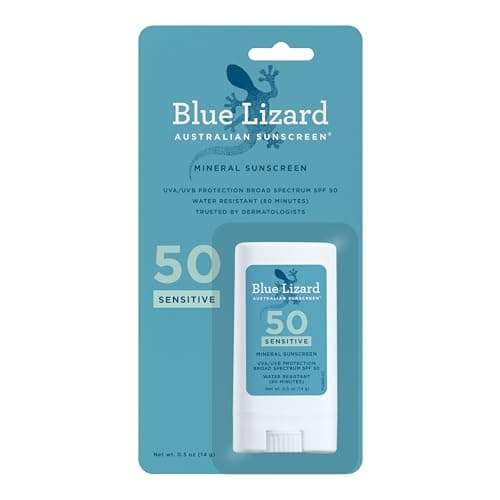
Blue Lizard Sensitive Mineral Sunscreen Stick SPF 50+
Blue Lizard · Read our Blue Lizard review
20% zinc oxide at SPF 50+ with 80 minutes of water resistance, in a stick. A stick cannot leak over your registration and has no emulsion to separate — though it will soften if the car gets hot enough.
- Actives:
- 20% zinc oxide
- SPF:
- SPF 50+
- Water resistance:
- 80 minutes
- Reef status:
- Zinc only — no oxybenzone, octinoxate or octocrylene
- Best for:
- Keeping something usable in the car year-round
What works
- Nothing to spill in a glovebox
- Zinc-only actives at the maximum water-resistance claim
- Small enough to keep a spare in the console
The trade-off
- Will soften and re-set out of shape in extreme heat
- Thin film — several passes needed
- Too small to cover a body
#ad We earn from qualifying purchases · Price as of November 2, 2026
Where in the car, if you are going to do it anyway
- Not the dashboard, and not a sunny seat. Direct sun on a dark surface is the hottest spot in the vehicle and adds UV exposure on top of the heat.
- The glovebox or center console beats the open cabin, because both are shaded and insulated by the dash.
- Under a seat is better still, since the floor stays cooler than anything at window level.
- The trunk is a mixed bag — shaded, but it can hold heat for hours after the cabin has cooled.
- Best of all, use an insulated bag. The same soft cooler that holds drinks keeps a bottle out of the worst of it, and costs nothing extra if it is already going to the beach.
And buy for the season. A bottle you will finish in two months has less time to degrade than a bulk container you top up from all year, which is the opposite of the advice we would give for a bottle living in a bathroom cabinet.
Is a heat-stressed sunscreen dangerous?
The concern is almost entirely about reduced effectiveness rather than harm. A sunscreen whose emulsion has broken is not toxic; it is unreliable. The practical risk is behavioral — you apply it, believe you are protected, and get a dose of UV you had planned around. That is the same failure mode as applying too little, and it is the reason we treat dose and product condition as the same category of problem.
One genuine chemistry caveat is worth naming honestly. Aerosol sunscreens were subject to a voluntary recall in 2021 over benzene detected in some batches, which is a contamination issue in manufacture rather than a heat issue — we mention it only because the two concerns get conflated in discussions about sprays in hot cars. The recall was not about storage temperature.
The short version
An afternoon in a hot car does not ruin sunscreen. A summer does. Keep a stick in the glovebox for convenience, keep the main bottle indoors, keep aerosols out of parked cars on principle, and replace anything that pours thin, smells different or has melted out of shape. If in doubt, the bottle is the cheapest part of the day.
If what you actually need is a sunscreen that travels well rather than one that lives in a car, the best travel-size sunscreens covers the formats built for bags, pockets and carry-ons.
Sources
- Sunscreen: How to Help Protect Your Skin from the Sun — U.S. Food and Drug Administration
- Questions and Answers: FDA Requirements for Over-the-Counter Sunscreen Products — U.S. Food and Drug Administration
- Sunscreen FAQs — American Academy of Dermatology
- Johnson & Johnson Consumer Inc. Issues Voluntary Recall of Specific NEUTROGENA and AVEENO Aerosol Sunscreen Products Due to the Presence of Benzene — Johnson & Johnson Consumer Inc.
- 21 CFR 201.327 — Over-the-counter sunscreen drug products; required labeling — Legal Information Institute, Cornell Law School
Frequently asked questions
Can you leave sunscreen in a hot car?
For an afternoon, yes. For a season, no. The FDA advises protecting sunscreen from excessive heat and not leaving it in a car on a hot day, because heat speeds up both filter breakdown and separation of the emulsion. If you keep a bottle in the car, treat it as a one-season item.
Does heat ruin sunscreen?
It degrades it. Heat accelerates the chemical breakdown of the actives and thins the emulsion holding them in suspension, so the product spreads unevenly and absorbs less UV than it was tested on. Neither failure is visible until the product pours or spreads oddly.
Will sunscreen explode in a hot car?
A lotion bottle will not. At worst it swells and weeps around the cap. An aerosol can is pressurized and its own label warns against storing it above specified temperatures or in direct sun, so aerosols are the one format worth keeping out of a parked car.
How can you tell if sunscreen has gone bad?
It pours thinner than it used to, it has separated into layers, the color or smell has changed, it feels grainy or stringy on skin, or a stick has melted and re-set. Any of those, or a passed expiration date, means replace it.
Where is the best place to keep sunscreen in a car?
In an insulated bag if you have one, otherwise the glovebox, center console or under a seat. Avoid the dashboard and any sunny seat, which combine the highest temperatures with direct UV on the bottle.
Read next
Sun Safety
Does sunscreen expire?
How long sunscreen lasts, what heat does to it, and the signs a bottle should be thrown out.
Sun Safety
The best travel-size sunscreens
Why a stick beats a mini bottle in a carry-on, the mineral travel formats worth packing, and the dose trade-off each one makes.
Sun Safety
The best sunscreen sticks
The sunscreen sticks worth buying, what their actives panels say, and the number of passes it takes to reach the SPF on the tube.
Sun Safety
The best spray sunscreens
The spray sunscreens worth buying, what their labels actually say, and the technique that decides whether a can protects anything.
Sun Safety
How long does sunscreen last on skin?
Why the two-hour rule exists, what actually removes a sunscreen film, and how long a layer really lasts indoors or on a still day with no sweat and no water.
Sun Safety
Can you bring sunscreen on a plane?
The TSA and FAA rules for packing sunscreen in carry-on and checked bags, including aerosols — and the format that sidesteps the liquids rule entirely.