Sun Safety
Does sunscreen prevent tanning?
It slows a tan rather than stopping one — and the reason tells you something important about what a tan is.
Disclosure: Spf & Shore earns commission from qualifying purchases made through links on this page, at no extra cost to you. It does not change which products we recommend. Read the full disclosure.
Sunscreen reduces tanning substantially but rarely prevents it, for two reasons: no sunscreen blocks 100% of UV, and almost nobody applies the amount SPF is tested at. Even applied perfectly, an SPF 50 lets through a small fraction of UV — and a small fraction of a long beach day is still enough UV to trigger pigment. If you want no tan at all, shade and clothing are the only reliable answers.
The more useful framing is what a tan is. Melanin production is the skin's response to UV damage in its own cells — a repair and shielding reaction, not a sign of health. The Skin Cancer Foundation puts it plainly: a tan is a sign of skin damage. So "did I still tan through my sunscreen" is really the question "did UV still reach my skin", and the honest answer is almost always yes, just less of it.
Why some UV always gets through
SPF is a ratio, not a wall. An SPF 30 applied at the tested dose lets through roughly one part in thirty of the UVB that would otherwise reach your skin; SPF 50 roughly one part in fifty. Those are small fractions, which is why sunburn is prevented so effectively — burning needs a large dose. Pigment needs much less, so the leftover fraction over four hours on open water is comfortably enough to deepen your colour.
Then there is application. The test dose is two milligrams per square centimeter — about an ounce for an adult body. Real-world application is consistently a quarter to a half of that, and protection falls faster than the amount skipped, so the effective SPF people get from an SPF 50 bottle is frequently in the teens. How much sunscreen to apply sets out the dose by body area.
What a tan actually is
- Immediate darkening happens within minutes to hours, as existing melanin oxidises. It fades quickly and offers almost no protection.
- Delayed tanning appears over days as the skin produces new melanin. This is the response to UV reaching the living layer of the skin and damaging DNA there.
- The protection a tan provides is small. A deep tan is generally estimated to be worth only a few SPF points — it is not a substitute for sunscreen, and acquiring it costs the damage that produced it.
- A base tan does not prevent burning. It raises the burn threshold slightly while adding to cumulative damage, which is a bad trade in both directions.
So why does sunscreen matter if I tan anyway?
Because the dose is what harms you, and sunscreen cuts the dose. Randomised trial evidence has linked regular sunscreen use to fewer squamous cell carcinomas, fewer melanomas on long follow-up, and measurably less photoaging. None of those outcomes depends on finishing the summer pale. A lighter tan is the visible sign that you took a smaller dose of UV — which was the point.
Put differently: the goal is not zero pigment, it is less damage. Judging sunscreen by whether you tanned is like judging a seatbelt by whether you felt the brakes.
If you genuinely want no tan
- Cover the skin. A UPF 50+ shirt blocks at least 98% of UV while worn, which is more than any sunscreen achieves in practice, and it cannot be under-applied. How UPF clothing works.
- Wear a wide brim. Face, ears and the back of the neck are where tan lines and damage both concentrate.
- Use shade in the middle of the day, when UV is at its highest. The best beach shade and umbrellas.
- Apply a full dose of SPF 50 and reapply every two hours, which is as far as sunscreen alone can take you.
- Add a tinted mineral formula on your face. Iron oxides absorb visible light as well, which contributes to pigmentation on deeper skin tones. Iron oxides and visible light.
Our picks in detail
01 · Best for cutting the dose
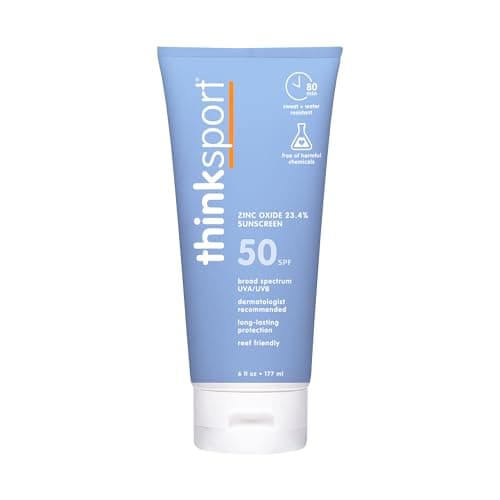
Thinksport Sunscreen SPF 50+
Thinksport · Read our Thinksport review
20% non-nano zinc at SPF 50+ with the maximum 80 minutes of water resistance, in tubes large enough to apply a genuine ounce — the combination that gets real-world protection closest to the label.
- Actives:
- 20% non-nano zinc oxide
- SPF:
- SPF 50+
- Water resistance:
- 80 minutes
- Reef status:
- Zinc only — no oxybenzone, octinoxate or octocrylene
- Best for:
- A full day outdoors with the fewest gaps
What works
- SPF 50+ with 80-minute water resistance
- Zinc-only
- Large tubes
The trade-off
- Visible white cast
- Heavy on a face
#ad We earn from qualifying purchases · Price as of October 10, 2026
02 · Best for facial pigmentation
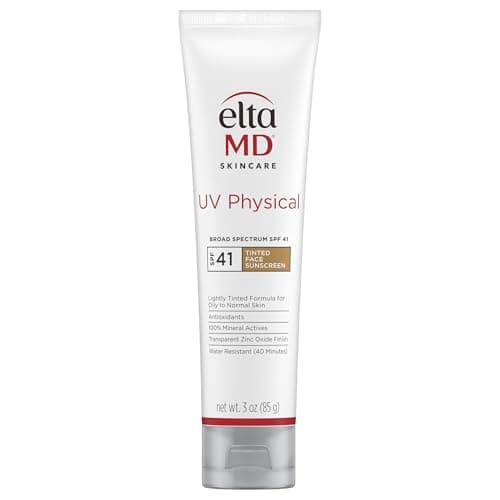
EltaMD UV Physical Tinted Broad-Spectrum SPF 41
EltaMD · Read our EltaMD review
Mineral filters under an iron-oxide tint — the tint adds visible-light protection the UV filters do not provide, which is the part of the spectrum most associated with pigmentation.
- Actives:
- Zinc oxide and titanium dioxide, tinted with iron oxides
- SPF:
- SPF 41
- Water resistance:
- 40 minutes
- Reef status:
- Mineral filters only
- Best for:
- Faces where the concern is uneven colour, not burning
What works
- Iron oxides absorb visible light
- Mineral filters only
- 40 minutes of water resistance
The trade-off
- One universal tint
- Dermatology-counter pricing
#ad We earn from qualifying purchases · Price as of October 10, 2026
03 · The only reliable answer
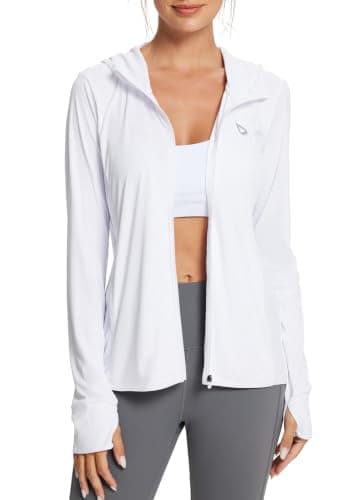
Baleaf UPF 50+ Sun Protection Hoodie
Baleaf
A UPF 50+ hooded knit blocks at least 98% of UV for as long as it is worn and cannot be applied too thinly — the one form of sun protection that genuinely prevents a tan on what it covers.
- Actives:
- Polyester-spandex knit rated UPF 50+
- SPF:
- UPF 50+
- Water resistance:
- Quick-dry; rated dry
- Reef status:
- Not applicable
- Best for:
- Skin you want to keep entirely untanned
What works
- Blocks at least 98% of UV
- Nothing to reapply
- Covers arms, torso and neck
The trade-off
- Rated dry rather than wet
- Warm in still, humid air
#ad We earn from qualifying purchases · Price as of October 10, 2026
What about tanning with sunscreen on purpose?
Low-SPF "tanning" products exist and are regulated as sunscreens, but a product sold at SPF 4 or 8 is an invitation to a large UV dose with a thin margin against burning. If a bronze look is the goal, a self-tanner delivers it with no UV at all — while providing no sun protection, so sunscreen is still required on top. Sunscreen versus suntan lotion compares what the two categories actually are.
Sources
- Tanning — The Skin Cancer Foundation
- Sunscreen FAQs — American Academy of Dermatology
- Sunscreen: How to Help Protect Your Skin from the Sun — U.S. Food and Drug Administration
- Sunburn — Skin Cancer Foundation
- Reduced melanoma after regular sunscreen use: randomized trial follow-up — Green et al., Journal of Clinical Oncology (2011)
- Sunscreen and prevention of skin aging: a randomized trial — Hughes et al., Annals of Internal Medicine (2013)
Frequently asked questions
Does sunscreen prevent tanning?
It reduces tanning a lot but rarely prevents it. No sunscreen blocks all UV, and most people apply a quarter to a half of the dose SPF is tested at, so enough UV reaches the skin to trigger pigment over a long day.
Why do I still tan with SPF 50 on?
SPF 50 lets through roughly one part in fifty of UVB when applied at the test dose, and far more than that at the amount people really apply. Burning needs a large dose; tanning needs much less.
Is a tan bad for you?
A tan is the skin's response to UV damage in its own cells, which is why the Skin Cancer Foundation describes it as a sign of skin damage rather than of health. The pigment itself is protective, but acquiring it costs the damage that caused it.
Does a base tan protect you?
Barely. A deep tan is generally estimated to be worth only a few SPF points, and it is acquired by taking the UV dose you were trying to avoid. It does not reliably prevent burning.
What actually stops you tanning?
Clothing and shade. A UPF 50+ shirt blocks at least 98% of UV while worn and cannot be under-applied, which is more than sunscreen achieves in practice.
Read next
Sun Safety
Sunscreen versus suntan lotion
Suntan lotion is not a regulated term and tanning oils still sell at SPF 4. What the Drug Facts panel tells you, and what to buy instead.
Sun Safety
Sunscreen versus no sunscreen
What the Nambour trial found when it randomized a whole town to daily sunscreen or not: skin aging, squamous cell carcinoma, melanoma, and the endpoints that did not move.
Sun Safety
How much sunscreen to apply
The measures by body area, and why under-application costs more protection than it seems.
Sun Safety
SPF 30 vs SPF 50
What the numbers actually mean, why the gap looks different depending on framing, and which to buy.
Sun Protective Gear
How UPF clothing works
What makes fabric block UV, why good garments do not wash out, and what actually degrades protection.