Reef-Safe & Ingredients
Is zinc oxide sunscreen reef safe?
It satisfies every restriction currently in force. That is a different claim from being proven harmless, and the difference is worth understanding.
Disclosure: Spf & Shore earns commission from qualifying purchases made through links on this page, at no extra cost to you. It does not change which products we recommend. Read the full disclosure.
Zinc oxide satisfies every sunscreen restriction currently in force — Hawaii, Key West, the US Virgin Islands, Palau, Bonaire and Aruba all restrict specific chemical filters and none restricts zinc oxide. So a zinc sunscreen is the compliant choice everywhere. What it is not is certified reef safe, because no authority certifies that term for any product.
Those two statements are both true and they are regularly collapsed into one. Below is what the laws actually say about zinc, what research has and has not established about mineral filters in seawater, and what a snorkeller can do that matters more than the bottle choice.
What the laws say about zinc oxide
Nothing — and that is the point. Every restriction in force names chemical filters: oxybenzone and octinoxate in most jurisdictions, with octocrylene added in the US Virgin Islands and a broader list in Palau. Zinc oxide and titanium dioxide appear on none of them, so a sunscreen whose only actives are mineral passes in all six. Where reef-safe sunscreen is actually required sets out each jurisdiction and its scope.
That is a legal fact rather than an environmental verdict. Legislators acted on the specific laboratory evidence in front of them, which concerned oxybenzone and coral larvae. The absence of zinc from those lists reflects what was studied and legislated, not a finding that zinc is inert in seawater.
Why "reef safe" is not a certification
No regulator, standards body or marine authority defines or certifies the phrase. There is no test a product passes, no registry, and no penalty for using it. That is why it appears on bottles containing filters the law restricts, and why it is useless as a shortcut. What reef-safe sunscreen actually means covers the labelling problem, and reef-safe versus reef-friendly covers the marketing distinction between the two phrases, which is also nothing.
The only durable rule is to read the actives panel. Mineral-only is compliant everywhere; a front-of-pack claim tells you nothing.
What is established, and what is open
| Question | Where it stands |
|---|---|
| Is zinc oxide restricted anywhere? | No. Every sunscreen restriction in force names chemical filters only. |
| Is zinc oxide certified reef safe? | No product is. The term has no certifying body and no definition. |
| Does oxybenzone harm coral? | Laboratory research found harm to coral larvae at measurable concentrations, which is the evidence the laws were built on. NOAA presents those findings alongside their limits. |
| Do mineral filters affect marine organisms? | Research exists on metal-oxide nanoparticles and marine life, and the picture is not settled. It has not produced the clear concentration-and-effect case that drove the chemical-filter bans. |
| What drives coral loss globally? | Ocean warming is the dominant driver. Sunscreen is a local, concentrated-exposure issue in heavily used swimming areas. |
Non-nano zinc, and the reef argument for it
Many mineral sunscreens marketed for reef destinations advertise non-nano zinc, and the reasoning offered is that larger particles are less bioavailable to small marine organisms than nanoparticles. It is a plausible precautionary argument rather than a demonstrated one, and the research that exists on metal-oxide nanoparticles in marine environments has not settled it either way.
Taken on its own terms it costs you nothing: non-nano zinc performs identically as a sunscreen and is widely available. The trade-off is cosmetic, since larger particles scatter more visible light and therefore show more on skin. Non-nano versus nano zinc oxide covers what each term actually covers.
What to buy for a reef trip
- A mineral body sunscreen with 80 minutes of water resistance, in a size that lasts the trip — the alternative is paying resort prices.
- Non-nano zinc if the precautionary argument appeals to you, accepting a slightly more visible finish.
- A separate mineral face formula, because a week of body lotion on a face is unpleasant.
- A stick for noses, ears and the tops of feet, which burn first under reflected light off water.
- A UPF 50+ rash guard, which is both the best torso protection and the thing that puts least product in the water. The best sun shirts.
Our picks in detail
01 · Best to pack
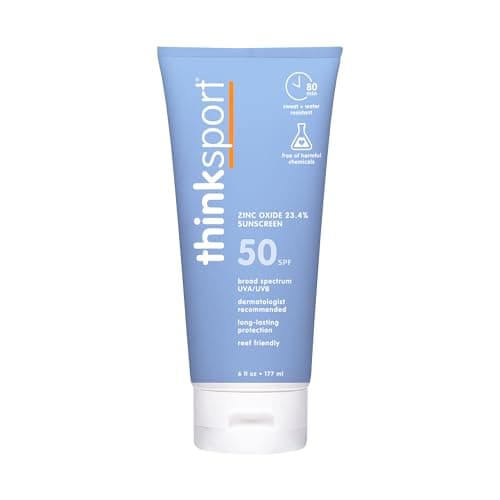
Thinksport Sunscreen SPF 50+
Thinksport · Read our Thinksport review
20% non-nano zinc oxide as the only filter with 80 minutes of water resistance, in large tubes — compliant in every restricted jurisdiction and sized for a week of generous use.
- Actives:
- 20% non-nano zinc oxide
- SPF:
- SPF 50+
- Water resistance:
- 80 minutes
- Reef status:
- Zinc only — no oxybenzone, octinoxate or octocrylene
- Best for:
- A single compliant bottle for a whole trip
What works
- Non-nano zinc as the only active
- Maximum labeled water resistance
- Large sizes for a trip
The trade-off
- Visible white cast
- Heavy on a face
#ad We earn from qualifying purchases · Price as of October 10, 2026
02 · Clearest non-nano option

Badger Clear Zinc Sunscreen SPF 40
Badger · Read our Badger review
Non-nano zinc oxide in a clear-zinc formulation — the precautionary particle size without the full white film that usually comes with it.
- Actives:
- Non-nano zinc oxide
- SPF:
- SPF 40
- Water resistance:
- 40 minutes
- Reef status:
- Zinc only
- Best for:
- Non-nano zinc with less of the chalk
What works
- Non-nano zinc only
- Less cast than a standard zinc paste
- Short ingredient list
The trade-off
- 40 minutes of water resistance
- Thick to spread
03 · Best for the spots that burn
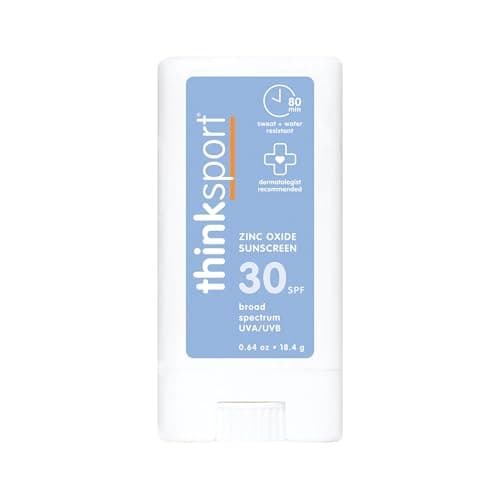
Thinksport Sunscreen Stick SPF 30+
Thinksport · Read our Thinksport review
24% zinc oxide with 80 minutes of water resistance in a stick — zinc-only, unrestricted everywhere, and the format that reaches the spots reflected UV off water finds first.
- Actives:
- 24% zinc oxide
- SPF:
- SPF 30+
- Water resistance:
- 80 minutes
- Reef status:
- Zinc only — no oxybenzone, octinoxate or octocrylene
- Best for:
- Noses, ears and the tops of feet in reflected light
What works
- Zinc-only
- Maximum water resistance
- No spill in a wet bag
The trade-off
- Obvious white film
- Slow over large areas
#ad We earn from qualifying purchases · Price as of October 10, 2026
The change that beats the bottle choice
Wearing a rash guard. Every square inch of covered skin is an inch you do not have to coat and therefore product that never enters the water at all, which addresses the concentration argument directly rather than by substitution. On a snorkelling trip a long-sleeve top plus mineral sunscreen on the remaining skin is both better protection and a smaller environmental footprint than any sunscreen choice alone.
Two smaller habits help as well. Apply at least fifteen minutes before you get in, so the film has set rather than washing straight off. And rinse under a shower rather than in the shallows at the end of a snorkel, which is where the concentration argument is strongest.
Sources
- Sunscreen chemicals and coral reefs — NOAA National Ocean Service
- Coral Reefs — U.S. Environmental Protection Agency
- Sunscreen: How to Help Protect Your Skin from the Sun — U.S. Food and Drug Administration
- Sunscreen Drug Products for Over-the-Counter Human Use (proposed rule) — Federal Register / FDA
- Sun-Protective Clothing — Skin Cancer Foundation
Frequently asked questions
Is zinc oxide sunscreen reef safe?
Zinc oxide is permitted by every sunscreen restriction in force, including Hawaii's, Key West's and Palau's, so it is the compliant choice everywhere. No sunscreen is certified reef safe, though, because the term has no definition or certifying body.
Is zinc oxide banned anywhere?
No. Every restriction currently in force names chemical filters — oxybenzone and octinoxate in most jurisdictions, with octocrylene added in the US Virgin Islands and a broader list in Palau.
Is non-nano zinc better for reefs than nano?
It is a precautionary argument rather than a settled finding: larger particles are thought to be less bioavailable to small marine organisms. Research on metal-oxide nanoparticles in marine environments has not resolved it. Non-nano costs nothing in protection, so choosing it is reasonable.
Does mineral sunscreen harm coral?
Research on metal-oxide nanoparticles and marine organisms exists and is not settled, but it has not produced the clear concentration-and-effect case that led to the chemical-filter bans. Ocean warming remains the dominant driver of coral loss.
What is the most reef-friendly thing I can actually do?
Wear a UPF 50+ rash guard. Covered skin needs no sunscreen, so less product enters the water at all — which addresses the concentration concern directly rather than by swapping filters.
Read next
Reef-Safe & Ingredients
The best reef-safe sunscreens
Mineral-only formulas that satisfy every current reef-protection law, chosen on the actives panel.
Reef-Safe & Ingredients
Where reef-safe sunscreen is actually required
Destination-by-destination restrictions, what each one covers, and what to pack.
Reef-Safe & Ingredients
What reef-safe sunscreen actually means
The unregulated claim, and the ingredient rules that actually matter — checkable in ten seconds.
Mineral Sunscreen
Non-nano vs nano zinc oxide
What the non-nano claim means, why brands advertise it, and whether the distinction should change what you buy.
Mineral Sunscreen
The best zinc oxide sunscreens
Zinc-only mineral sunscreens, compared on their published zinc percentage, SPF and water resistance.