Face & Tinted SPF
Does mineral sunscreen clog pores?
The filters almost certainly are not the problem. Four other things in the bottle and the routine are much likelier suspects.
Disclosure: Spf & Shore earns commission from qualifying purchases made through links on this page, at no extra cost to you. It does not change which products we recommend. Read the full disclosure.
Zinc oxide and titanium dioxide are not comedogenic — zinc oxide is the active ingredient in diaper-rash creams and calamine lotion precisely because it is well tolerated on compromised skin. When mineral sunscreen causes breakouts, the cause is almost always the base it is carried in, the amount applied, or incomplete removal at the end of the day.
That distinction matters because the usual response — abandoning mineral sunscreen — fixes nothing if the real culprit was an emollient-heavy base. Switching to a sheerer mineral formula solves it more often than switching filter types does.
What the filters actually do on skin
Mineral filters sit in a film on the surface of the skin and reflect, scatter and absorb UV there. They are inorganic powders — they do not penetrate into a pore the way an oil does, and they do not dissolve in sebum. Zinc oxide in particular is mildly astringent and is used in over-the-counter skin-protectant products for exactly that reason.
There is a real mechanical effect, though, and it is worth naming honestly: a mineral film is occlusive. On a hot day, with sweat underneath and nothing to let it out, that film can contribute to the clogged-feeling congestion and the small bumps people describe as sunscreen acne. That is an application and format issue, not a filter safety issue.
The four likelier causes
- The base. Mineral filters need carrying, and body formulas carry them in heavy emollients. A 20% zinc body lotion on a face is the single most common cause of this complaint.
- Fragrance and essential oils, which cause irritation that presents as bumps and which have no protective function whatsoever.
- Too thick a layer at once. A full facial dose applied as one heavy coat sits rather than sets. Two thin layers behave differently.
- Incomplete removal. A water-resistant mineral film is designed not to rinse off. If water alone is your evening routine, some of it is still there in the morning, under the next layer.
A fifth possibility, often misread: if you are using retinoids, benzoyl peroxide or acids, those thin and sensitize the outer layer, and the resulting irritation can look like congestion. The best sunscreen for acne-prone skin covers the interaction.
What to look for instead
A facial formula rather than a body one, a lower total mineral percentage, no fragrance, and a finish described as sheer or matte rather than hydrating. If your skin is oily as well as congested, a loose mineral powder reapplied over the top absorbs oil instead of adding to it. The best sunscreen for oily skin compares the matte options.
And whatever you choose, keep wearing something. Several acne treatments increase sun sensitivity, and post-inflammatory marks from a breakout darken with UV exposure — so skipping sunscreen makes the visible result of acne worse even when it does nothing to the acne itself.
Our picks in detail
01 · Best everyday facial mineral
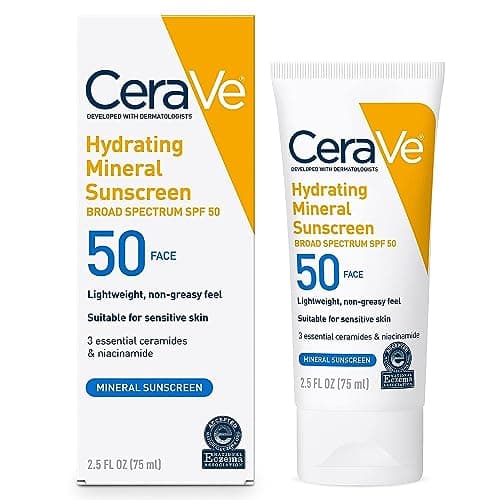
CeraVe Hydrating Mineral Sunscreen SPF 50 Face
CeraVe · Read our CeraVe review
Mineral filters at SPF 50 in a ceramide base rather than a heavy emollient one — a facial formula, which is the single most useful change if a body lotion caused the problem.
- Actives:
- Zinc oxide and titanium dioxide, with ceramides and hyaluronic acid
- SPF:
- SPF 50
- Water resistance:
- 40 minutes
- Reef status:
- Mineral filters only
- Best for:
- Congestion-prone skin that still wants mineral filters
What works
- Fragrance-free
- Ceramides support the barrier
- Widely available
The trade-off
- 40 minutes of water resistance
- Soft cast on deeper skin tones
#ad We earn from qualifying purchases · Price as of October 11, 2026
02 · Lightest facial finish
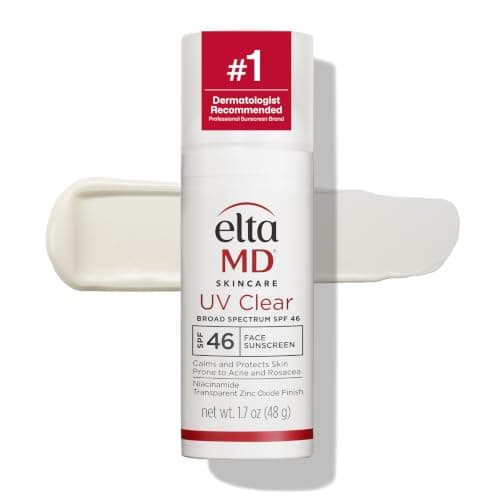
EltaMD UV Clear Broad-Spectrum SPF 46
EltaMD · Read our EltaMD review
A hybrid panel with 9% zinc oxide and 5% niacinamide in the lightest base here — the formula least likely to sit on the skin long enough to feel occlusive.
- Actives:
- Zinc oxide with octinoxate; EltaMD lists 9% zinc oxide and 5% niacinamide
- SPF:
- SPF 46
- Water resistance:
- Not labeled water resistant
- Reef status:
- Contains octinoxate, which Hawaii and Key West restrict
- Best for:
- Oily, congested skin where any heaviness shows
What works
- Weightless finish
- Niacinamide in the base
- Fragrance-free
The trade-off
- Contains octinoxate
- Not labeled water resistant
#ad We earn from qualifying purchases · Price as of October 11, 2026
03 · Best for reapplying without layering

Colorescience Sunforgettable Total Protection Brush-On Shield SPF 50
Colorescience · Read our Colorescience review
A loose mineral powder at SPF 50 — it adds protection and absorbs oil without putting another occlusive film over an already congested face.
- Actives:
- Zinc oxide and titanium dioxide in a loose mineral powder
- SPF:
- SPF 50
- Water resistance:
- 80 minutes
- Reef status:
- Mineral filters only
- Best for:
- Midday protection on skin that cannot take another lotion
What works
- No emollient base at all
- Absorbs oil
- SPF 50 with 80 minutes
The trade-off
- Hard to apply a full dose
- A top-up rather than a base layer
Getting it off properly
- Use an actual cleanser at night, not water. Water-resistant films are built to survive water.
- Double cleanse if you wore a water-resistant or tinted formula — an oil or balm first to break the film, then your usual cleanser.
- Do not scrub. Friction on congested skin makes the bumps angrier; the film comes off with product, not pressure.
- Give a new sunscreen two weeks before judging it. A single bad day is weather, not a verdict.
- Change one thing at a time. Switching formula and cleanser together tells you nothing about which fixed it.
Sources
- Sunscreen FAQs — American Academy of Dermatology
- Sunscreen: How to Help Protect Your Skin from the Sun — U.S. Food and Drug Administration
- Questions and Answers: FDA Requirements for Over-the-Counter Sunscreen Products — U.S. Food and Drug Administration
- Sunscreen — Skin Cancer Foundation
Frequently asked questions
Does mineral sunscreen clog pores?
The filters do not. Zinc oxide and titanium dioxide are inorganic powders that sit on the surface, and zinc oxide is used in skin-protectant products for its tolerance. Breakouts blamed on mineral sunscreen usually come from the emollient base, too thick a layer, or incomplete removal.
Is zinc oxide comedogenic?
No. Zinc oxide is not considered comedogenic and is the active ingredient in diaper-rash and skin-protectant creams. It is also mildly astringent, which is why it suits oily skin better than its reputation suggests.
Why does sunscreen give me little bumps?
Most often fragrance or essential oils causing irritation, a heavy occlusive base trapping sweat, or sunscreen left on overnight because water alone will not remove a water-resistant film. Switching to a fragrance-free facial formula and double cleansing resolves most cases.
Should I use chemical sunscreen if mineral breaks me out?
Try a sheerer mineral facial formula first — it fixes the problem more often, because the base rather than the filter was usually at fault. Chemical formulas are a reasonable next step if that does not work.
Do I need to wash sunscreen off at night?
Yes, with a cleanser. Water-resistant and tinted formulas are built to survive water, so rinsing leaves product on the skin under the next day's layer — which is a genuine cause of congestion.
Read next
Face & Tinted SPF
The best sunscreen for acne-prone skin
Light, oil-free face SPF for acne-prone skin — chosen on the base and the finish, not just the filter.
Face & Tinted SPF
The best sunscreen for oily skin
Sunscreens that stay matte on oily skin, chosen on base and finish rather than filter type, with the powder that fixes midday shine.

Face & Tinted SPF
The best face sunscreen for sensitive skin
Fragrance-free mineral face formulas for reactive skin, and the ingredient groups that trigger most reactions.
Mineral Sunscreen
Mineral vs chemical sunscreen
How each filter type works, what the absorption research actually found, and which to choose for your situation.
Face & Tinted SPF
Where sunscreen goes in your routine
The correct order, why pilling happens, and how to reapply over a finished face.