Face & Tinted SPF
Can you use body sunscreen on your face?
The filters are identical and the protection is real. What differs is the base, and on a face the base is the whole argument.
Disclosure: Spf & Shore earns commission from qualifying purchases made through links on this page, at no extra cost to you. It does not change which products we recommend. Read the full disclosure.
Yes. There is no separate FDA category for facial sunscreen, no filter approved for one and not the other, and a body SPF 50 protects a face exactly as well as it protects a shoulder. What differs is the base — thickness, oils, fragrance and finish — and on a face that decides whether you wear it tomorrow.
So the practical answer splits. On a beach day, use the body bottle on your face and do not think about it; it is far better than the alternative of applying nothing because the face product is at home. For daily wear, a facial formula is worth the second purchase, because the only sunscreen that protects you is the one you keep using.
What is actually different
Four things, none of them the filters.
- Thickness and emollient load. Body lotions are built to spread over a large area and stay put, which usually means more oils. On a face that reads greasy and can feel occlusive.
- Fragrance. Common in body formulas, and the single most frequent cause of irritation on facial skin, which is thinner and closer to the eyes.
- Finish and cast. A 20% or 24% zinc body lotion leaves a visible film. Nobody is examining your shins; your face is a different matter.
- Extras in the base. Facial formulas often carry niacinamide, ceramides, antioxidants or an iron-oxide tint. Those are reasons to buy a face product, not reasons the body one fails.
One real asymmetry: facial formulas are frequently *weaker* on water resistance. A body SPF 50 commonly carries 80 minutes while a facial SPF 46 may not be labeled water resistant at all. For sport, sweat and swimming, the body bottle is the better choice for your face too.
When the body bottle is the right call
- Beach, pool, hiking, any long day outdoors. You need the water resistance and the volume, and you need to reapply without rationing.
- On children. One bottle, applied everywhere, is the routine that survives a real morning. The best sunscreen for kids.
- When the face product has run out. Applying something always beats applying nothing.
- On a body sunscreen that is already fragrance-free and mineral. Several of them are perfectly comfortable on a face.
When to buy a face formula instead
If your skin is oily, acne-prone, rosacea-prone or reactive, and above all if you intend to wear SPF every day. Daily wear is where texture compounds: a formula that is merely tolerable becomes the reason a habit stops in week three. A facial formula also solves the two problems that end most daily attempts — stinging eyes and visible cast.
For deeper skin tones specifically, an untinted body mineral will read gray on a face in a way it does not on a leg, and a tint is the fix rather than a cosmetic preference. The best tinted sunscreen for deeper skin tones.
Our picks in detail
01 · Best body formula that suits a face
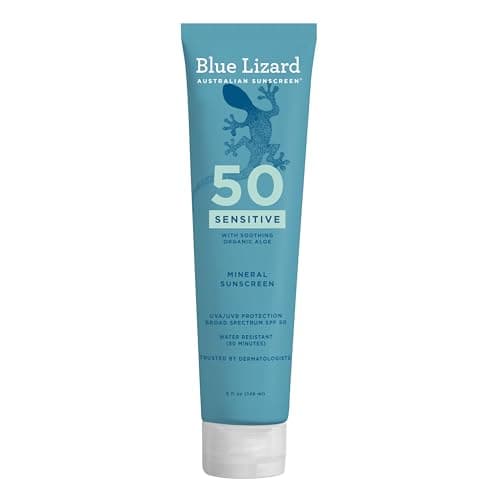
Blue Lizard Sensitive Mineral Sunscreen SPF 50+
Blue Lizard · Read our Blue Lizard review
Mineral filters, fragrance-free, SPF 50+ with 80 minutes of water resistance — a body sunscreen with none of the usual reasons a body sunscreen fails on a face.
- Actives:
- Zinc oxide and titanium dioxide
- SPF:
- SPF 50+
- Water resistance:
- 80 minutes
- Reef status:
- Mineral filters only; the Sensitive formula omits oxybenzone and octinoxate
- Best for:
- One bottle for everything, faces included
What works
- Fragrance-free mineral filters
- SPF 50+ and 80 minutes of water resistance
- Does not sting
The trade-off
- Visible cast
- Thicker than a facial lotion
#ad We earn from qualifying purchases · Price as of October 11, 2026
02 · Best reason to buy a face formula
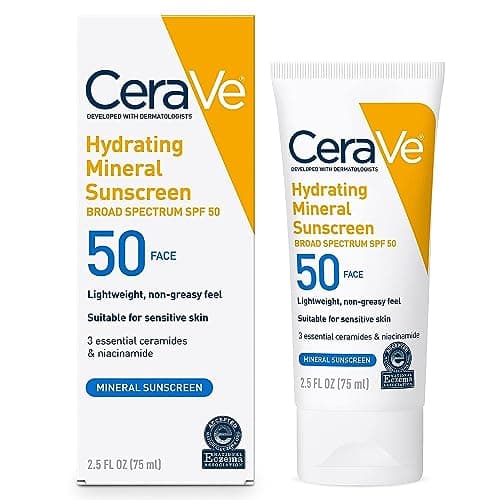
CeraVe Hydrating Mineral Sunscreen SPF 50 Face
CeraVe · Read our CeraVe review
Mineral filters at SPF 50 in a ceramide base, in a tube built for a face — the drugstore version of why the second purchase is usually worth it.
- Actives:
- Zinc oxide and titanium dioxide, with ceramides and hyaluronic acid
- SPF:
- SPF 50
- Water resistance:
- 40 minutes
- Reef status:
- Mineral filters only
- Best for:
- Daily wear where texture decides the habit
What works
- Ceramides and hyaluronic acid
- Fragrance-free
- Drugstore price
The trade-off
- 40 minutes of water resistance
- Soft cast on deeper skin tones
#ad We earn from qualifying purchases · Price as of October 11, 2026
03 · Best compromise
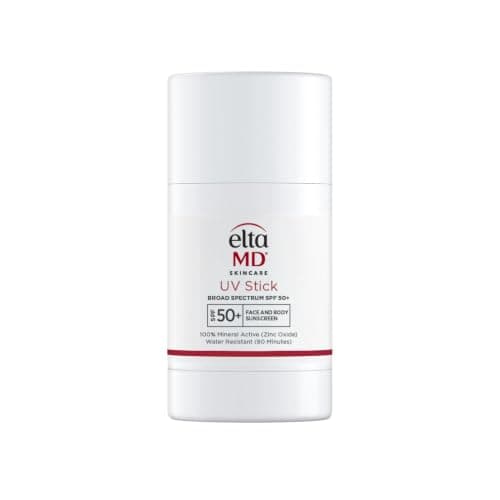
EltaMD UV Stick Broad Spectrum SPF 50+
EltaMD · Read our EltaMD review
22% transparent zinc at SPF 50+ with 80 minutes of water resistance — enough water resistance for sport and little enough cast to use on a face in public.
- Actives:
- 22% transparent zinc oxide
- SPF:
- SPF 50+
- Water resistance:
- 80 minutes
- Reef status:
- Zinc only — no oxybenzone, octinoxate or octocrylene
- Best for:
- Carrying one thing that works on a face and a body
What works
- Transparent zinc, minimal cast
- 80-minute water resistance
- Pocketable
The trade-off
- Slow over large areas
- Small for the price
#ad We earn from qualifying purchases · Price as of October 11, 2026
Applying a body sunscreen to a face properly
- Use about a quarter-teaspoon — a nickel-sized blob — for a face, ears and neck. The dose does not shrink because the product is thick.
- Two thin layers, not one thick one. Thick layers of body lotion slide and pill on a face.
- Keep it off the immediate eye area if it is a chemical formula, which is what stings when you sweat.
- Press rather than rub on the cheekbones and nose, which is where cast shows most.
- Remove it with a cleanser at night, not water. Water-resistant films are designed to survive water.
Sources
- Questions and Answers: FDA Requirements for Over-the-Counter Sunscreen Products — U.S. Food and Drug Administration
- Sunscreen: How to Help Protect Your Skin from the Sun — U.S. Food and Drug Administration
- Sunscreen FAQs — American Academy of Dermatology
- 21 CFR 201.327 — Over-the-counter sunscreen drug products; required labeling — Legal Information Institute, Cornell Law School
- Sunscreen — Skin Cancer Foundation
Frequently asked questions
Can you use body sunscreen on your face?
Yes. The filters and the FDA rules are identical, so a body SPF 50 protects a face as well as it protects a shoulder. The differences are thickness, fragrance and finish, which affect comfort rather than protection.
Is face sunscreen different from body sunscreen?
Only in the base. Facial formulas are thinner, more often fragrance-free, and frequently carry extras such as niacinamide, ceramides or a tint. They are also often weaker on water resistance than a body bottle.
Will body sunscreen cause breakouts on my face?
It can, but the cause is usually the emollient base or the fragrance rather than the filters. A fragrance-free mineral body formula is far less likely to than a scented one. Does mineral sunscreen clog pores?
Can you use face sunscreen on your body?
You can, but it is the worse direction. Small facial tubes encourage rationing, and many facial sunscreens carry no water-resistance claim at all — so you end up under-applying a weaker product over a much larger area.
Which is better for swimming, face or body sunscreen?
The body one, for your face as well. Body formulas commonly carry the maximum 80-minute water-resistance claim, while many facial sunscreens are not labeled water resistant.
Read next
Face & Tinted SPF
The best sunscreen for your face
Daily face SPF by skin type and finish, from mineral to hybrid, with the trade-off named on each.
Mineral Sunscreen
The best mineral sunscreen for your body
Mineral body formulas chosen for water resistance, spreadability and tube size — the things that decide whether you apply enough.

Sun Safety
How much sunscreen to apply
The measures by body area, and why under-application costs more protection than it seems.
Face & Tinted SPF
Does mineral sunscreen clog pores?
Why zinc oxide and titanium dioxide are not the cause of sunscreen breakouts, and the four things in the bottle and the routine that usually are.
Kids & Baby
Kids vs adult sunscreen
What genuinely differs between kids and adult formulas, and when the label is just packaging.