Sun Safety
Is sunscreen FSA or HSA eligible?
Yes — broad-spectrum SPF 15 or higher, no prescription needed. Tanning products and low-SPF cosmetics are not.
Disclosure: Spf & Shore earns commission from qualifying purchases made through links on this page, at no extra cost to you. It does not change which products we recommend. Read the full disclosure.
Yes. Sunscreen labeled broad spectrum at SPF 15 or higher is an eligible expense under a health care FSA and an HSA, and since the CARES Act took effect for expenses from January 1, 2020, it needs no prescription. Suntan and tanning products are not eligible, and neither is sunscreen below SPF 15.
This is one of the few places where the tax code and the dermatology advice point the same way. If you have an FSA balance to spend down, sunscreen is among the most useful things on the eligible list — and because it is consumable, buying enough of it to apply a full dose stops feeling wasteful.
What makes sunscreen eligible
Over-the-counter products bought to treat or prevent a medical condition are eligible for reimbursement from a health care FSA, and FSAFEDS lists sunscreen with SPF 15 or greater and a broad-spectrum claim as an eligible expense. The same reasoning applies to an HSA: IRS Publication 969 defines qualified medical expenses for HSAs by reference to the medical expense rules, and over-the-counter medicines and drugs became reimbursable without a prescription under the CARES Act.
The two label elements that decide it are the same two that decide whether a sunscreen is worth buying at all. *Broad spectrum* is a separate FDA test covering UVA as well as UVB. *SPF 15* is the floor at which US labels may claim to reduce the risk of skin cancer and early skin aging — below that, the label may only claim to prevent sunburn. How to read a sunscreen label walks through the panel.
What is not eligible
- Suntan lotion and tanning products, which are a different category even when they carry a low SPF. Sunscreen versus suntan lotion explains the difference.
- Sunscreen below SPF 15, or any product without a broad-spectrum claim.
- Cosmetics that happen to contain SPF, unless sun protection is the product's primary purpose — a tinted sunscreen generally qualifies where a foundation with incidental SPF does not.
- After-sun lotions and aloe gels, which are comfort products rather than preventives.
- UPF clothing and hats. They are effective sun protection but they are apparel, not an over-the-counter drug.
What to buy with it
Since the constraint is only SPF 15 and broad spectrum, every sunscreen worth owning clears the bar — so buy on the same criteria you would use with your own money. That means SPF 50 for long exposure, 80 minutes of water resistance for anything involving water or sweat, and enough volume to apply the tested dose rather than a polite smear.
The practical FSA strategy is to buy large. An ounce per full-body application means a household genuinely uses several large bottles a season, and under-application is the single biggest reason real-world protection falls short of the label. How much sunscreen to apply sets out the dose.
Our picks in detail
01 · Best all-round eligible pick
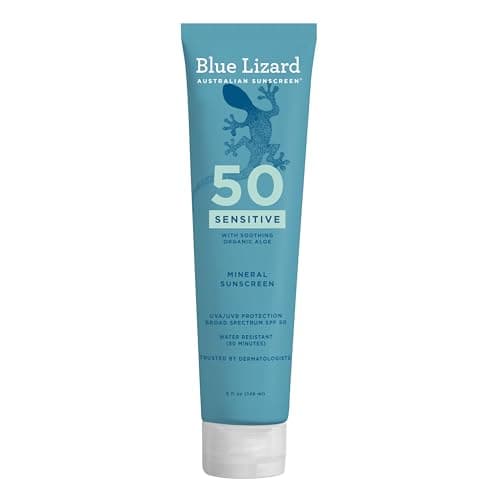
Blue Lizard Sensitive Mineral Sunscreen SPF 50+
Blue Lizard · Read our Blue Lizard review
Broad spectrum at SPF 50+ with mineral filters, fragrance-free, and the maximum 80 minutes of water resistance — clears the eligibility bar several times over.
- Actives:
- Zinc oxide and titanium dioxide
- SPF:
- SPF 50+
- Water resistance:
- 80 minutes
- Reef status:
- Mineral filters only; the Sensitive formula omits oxybenzone and octinoxate
- Best for:
- One bottle that covers a household
What works
- Broad spectrum at SPF 50+
- 80 minutes of water resistance
- Fragrance-free mineral filters
The trade-off
- Visible cast
- Thicker than a facial lotion
#ad We earn from qualifying purchases · Price as of October 11, 2026
02 · Best large size to buy with FSA funds
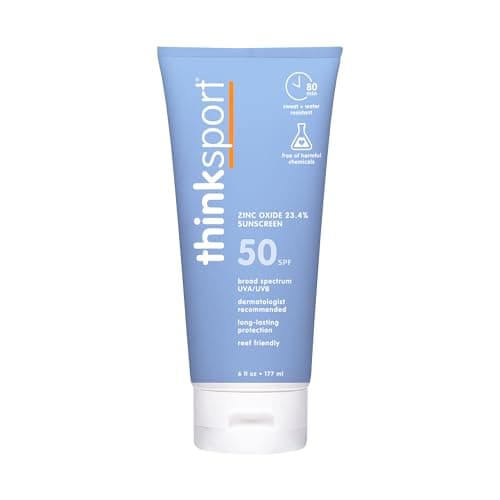
Thinksport Sunscreen SPF 50+
Thinksport · Read our Thinksport review
20% non-nano zinc at SPF 50+ with 80 minutes of water resistance in large tubes — the format that makes applying a genuine ounce a habit rather than an indulgence.
- Actives:
- 20% non-nano zinc oxide
- SPF:
- SPF 50+
- Water resistance:
- 80 minutes
- Reef status:
- Zinc only — no oxybenzone, octinoxate or octocrylene
- Best for:
- A season's worth of full-dose application
What works
- High published zinc percentage
- Maximum water resistance
- Large sizes
The trade-off
- Obvious white cast
- Heavy on a face
#ad We earn from qualifying purchases · Price as of October 11, 2026
03 · Best everyday eligible option
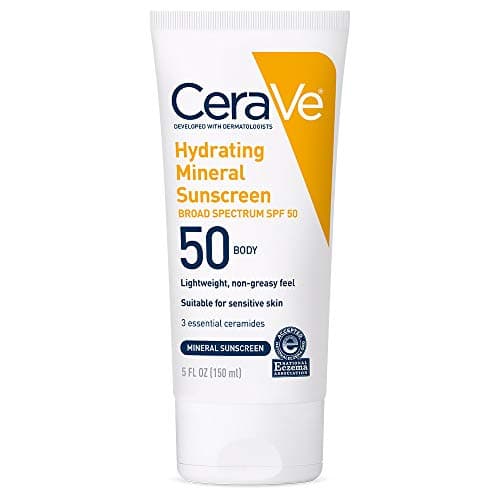
CeraVe Hydrating Mineral Sunscreen SPF 50 Body
CeraVe · Read our CeraVe review
Broad spectrum at SPF 50 with mineral filters in a ceramide base — the one most likely to get used every morning, which is what actually determines protection.
- Actives:
- Zinc oxide and titanium dioxide, with ceramides
- SPF:
- SPF 50
- Water resistance:
- 40 minutes
- Reef status:
- Mineral filters only
- Best for:
- Daily body use on dry or easily irritated skin
What works
- Mineral filters only
- Ceramide base
- Widely stocked
The trade-off
- 40 minutes of water resistance
- Soft cast
#ad We earn from qualifying purchases · Price as of October 11, 2026
How to claim it
- Use the benefits card at checkout where your administrator supports it — eligible OTC items are usually coded automatically.
- Otherwise keep the itemized receipt, which has to show the product name, the date and the amount, not just a card total.
- Keep the packaging or a photo of the label if the SPF or broad-spectrum claim is not obvious from the receipt line.
- Check your plan's own eligible list, since administrators vary at the margins even where the federal rules are identical.
- Spend down before the deadline. Health care FSA funds are generally use-it-or-lose-it; HSA funds roll over.
Sources
- Eligible Health Care FSA Expenses — FSAFEDS, U.S. Office of Personnel Management
- Over-the-counter medicines and drugs after the CARES Act — FSAFEDS, U.S. Office of Personnel Management
- Publication 969 — Health Savings Accounts and Other Tax-Favored Health Plans — Internal Revenue Service
- Questions and Answers: FDA Requirements for Over-the-Counter Sunscreen Products — U.S. Food and Drug Administration
- Sunscreen: How to Help Protect Your Skin from the Sun — U.S. Food and Drug Administration
- How to prevent skin cancer — American Academy of Dermatology
Frequently asked questions
Is sunscreen FSA eligible?
Yes. Sunscreen labeled broad spectrum at SPF 15 or higher is an eligible health care FSA expense, and no prescription has been required since the CARES Act applied to expenses from January 1, 2020.
Is sunscreen HSA eligible?
Yes, on the same basis. Over-the-counter medicines and drugs are reimbursable without a prescription, and IRS Publication 969 governs what counts as a qualified medical expense for an HSA.
What SPF do I need for it to be FSA eligible?
SPF 15 or higher, with a broad-spectrum claim on the label. SPF 15 is also the FDA threshold above which a sunscreen may claim to reduce skin cancer and early skin aging risk.
Is tanning lotion FSA eligible?
No. Suntan and tanning products are specifically excluded, even when they carry a low SPF, because sun protection is not their purpose.
Do I need a prescription for sunscreen to be reimbursed?
No. The CARES Act removed the prescription requirement for over-the-counter medicines and drugs for expenses incurred from January 1, 2020 onward.
Is UPF clothing FSA eligible?
Generally no. UPF shirts and hats are highly effective sun protection but they are apparel rather than an over-the-counter drug, so they sit outside the eligible list.
Read next
Reef-Safe & Ingredients
How to read a sunscreen label
How to read the drug facts panel line by line, and what every front-of-bottle claim is worth.
Sun Safety
The best sunscreens
One pick per situation — face, body, kids, water, sensitive skin — chosen on the label, not the packaging.

Sun Safety
How much sunscreen to apply
The measures by body area, and why under-application costs more protection than it seems.
Sun Safety
Sunscreen versus suntan lotion
Suntan lotion is not a regulated term and tanning oils still sell at SPF 4. What the Drug Facts panel tells you, and what to buy instead.
Sun Safety
SPF 30 vs SPF 50
What the numbers actually mean, why the gap looks different depending on framing, and which to buy.