Reef-Safe & Ingredients
Sunscreen allergy and sunscreen rash
A reaction to sunscreen is real, common and usually not caused by the UV filters at all.
Disclosure: Spf & Shore earns commission from qualifying purchases made through links on this page, at no extra cost to you. It does not change which products we recommend. Read the full disclosure.
Most sunscreen reactions are irritant reactions rather than true allergies, and the ingredient responsible is far more often a fragrance or a preservative in the base than a UV filter. Zinc oxide and titanium dioxide are among the least reactive ingredients in the category, which is why a fragrance-free mineral formula is the standard fallback for skin that has reacted before.
The distinction matters because the usual response — "I am allergic to sunscreen" — ends with people wearing none, which is a much worse outcome than a short process of elimination. Very few people cannot tolerate any sunscreen at all.
The three different things people call a sunscreen allergy
- Irritant contact reaction. Stinging, redness and a prickly feeling, usually within minutes, usually from fragrance, a preservative or alcohol. The most common by a wide margin.
- Allergic contact dermatitis. A delayed, itchy, sometimes blistering rash appearing a day or two after exposure, in the exact area the product was applied. This is a genuine immune response to a specific ingredient.
- Photoallergic reaction. The same kind of rash, but only in the areas that then got sun — so the pattern maps to exposure rather than to application. Some chemical UV filters are known triggers.
A fourth thing is frequently mistaken for all three: heat rash. Small itchy bumps on a torso or a hairline after a hot day are usually blocked sweat ducts under an occlusive layer, not an immune reaction to the filters. It resolves on its own and is best managed by using a lighter formula and more clothing-based shade rather than by changing filter type.
The usual culprits, in order
Fragrance first, always. It has no protective function, it is present in a large share of body sunscreens, and it is one of the most frequent causes of contact reactions to cosmetics generally. Removing it solves a large proportion of sunscreen reactions on its own.
After that: preservatives and botanical extracts in the base, then chemical UV filters. Among the filters, oxybenzone has the longest history of reported contact and photoallergic reactions, which is part of why it has fallen out of favor in US formulations — alongside the environmental restrictions. Oxybenzone versus avobenzone compares the two.
Zinc oxide and titanium dioxide sit at the bottom of that list. Zinc oxide is the active ingredient in diaper-rash creams and calamine lotion precisely because it is well tolerated on inflamed skin. That is the reason a mineral formula is the sensible starting point for an elimination process.
What to switch to
Fragrance-free, dye-free, mineral filters only, and the shortest inactive list you can find. That combination removes the most likely triggers in one move. If the reaction persists on a formula like that, the cause is more likely to be a preservative in the base than the filters, and a product with a genuinely minimal ingredient list is the next test.
Patch test rather than committing a whole face: apply a small amount to the inner forearm twice a day for several days before using a new sunscreen widely. If you have eczema or a compromised barrier, that step is worth making routine. The best sunscreen for sensitive skin sets out what to look for.
Our picks in detail
01 · Best for skin that has reacted before
Vanicream Mineral Sunscreen SPF 50+ for Sensitive Skin
Vanicream · Read our Vanicream review
Mineral filters at SPF 50+ with 80 minutes of water resistance in a deliberately plain, fragrance-free and dye-free base — a formula built around removing reasons to react.
- Actives:
- Zinc oxide and titanium dioxide
- SPF:
- SPF 50+
- Water resistance:
- 80 minutes
- Reef status:
- Mineral filters only
- Best for:
- A first attempt after a sunscreen reaction
What works
- Fragrance-free and dye-free
- Mineral filters only
- SPF 50+ with 80 minutes of water resistance
The trade-off
- Thick and casty
- Sold mainly through pharmacy channels
02 · Shortest inactive list
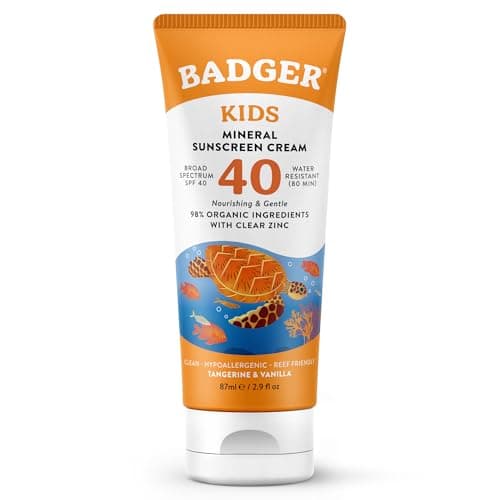
Badger Kids Sunscreen Cream SPF 40
Badger · Read our Badger review
Non-nano zinc oxide, which Badger lists at 22.5%, in a base of a handful of recognizable ingredients — the fewest variables to eliminate, and it suits adults despite the name.
- Actives:
- Non-nano zinc oxide, which Badger lists at 22.5%
- SPF:
- SPF 40
- Water resistance:
- 40 minutes
- Reef status:
- Zinc only — reef-relevant chemical filters absent
- Best for:
- Working out which base ingredient is the trigger
What works
- Very short ingredient list
- High published zinc percentage
- Emollient base
The trade-off
- Only 40 minutes of water resistance
- Needs working in
#ad We earn from qualifying purchases · Price as of October 11, 2026
03 · Best once you know what works
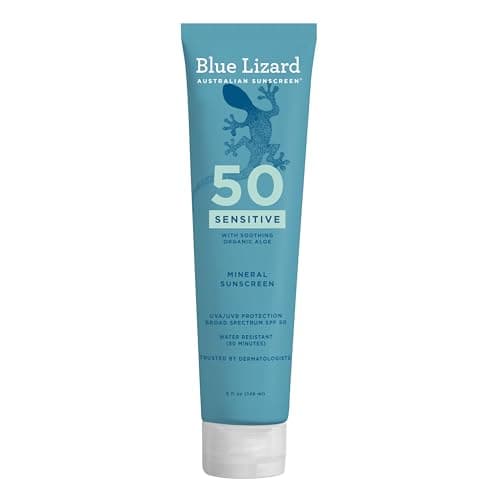
Blue Lizard Sensitive Mineral Sunscreen SPF 50+
Blue Lizard · Read our Blue Lizard review
Fragrance-free mineral filters at SPF 50+ with the maximum 80 minutes of water resistance — the gentle option that does not give up anything on the label claims.
- Actives:
- Zinc oxide and titanium dioxide
- SPF:
- SPF 50+
- Water resistance:
- 80 minutes
- Reef status:
- Mineral filters only; the Sensitive formula omits oxybenzone and octinoxate
- Best for:
- Sensitive skin that still needs real water resistance
What works
- Fragrance-free
- Mineral filters only
- Maximum labeled water resistance
The trade-off
- Noticeable cast
- Thick on a face
#ad We earn from qualifying purchases · Price as of October 11, 2026
If a reaction is already happening
- Wash the product off with a gentle cleanser and cool water rather than scrubbing.
- Cover up instead. A UPF 50+ shirt and a wide-brim hat give you real protection while the skin settles, with nothing applied. The best sun shirts.
- Keep the bottle. The ingredient list is the only evidence of what caused it, and it is what a dermatologist will want.
- See a clinician for a rash that blisters, spreads or does not settle within a few days, or for anything that keeps recurring on different products. Patch testing can identify the specific ingredient.
- Do not conclude you cannot wear sunscreen. Reintroduce with a fragrance-free mineral formula on a small area first.
One pattern worth recognizing: if the rash appears only where the sun then hit, and not where the product was applied under clothing, that points to a photoallergic reaction to a filter rather than a contact reaction to the base — and it changes the answer from "drop the fragrance" to "change the filter system".
Sources
- Sunscreen FAQs — American Academy of Dermatology
- Sunscreen: How to Help Protect Your Skin from the Sun — U.S. Food and Drug Administration
- Questions and Answers: FDA Requirements for Over-the-Counter Sunscreen Products — U.S. Food and Drug Administration
- Sunscreen — Skin Cancer Foundation
- About the NEA Seal of Acceptance — National Eczema Association
Frequently asked questions
Can you be allergic to sunscreen?
Yes, but true allergic contact dermatitis to sunscreen is much less common than irritant reactions. Fragrance and preservatives in the base cause most reactions; among the UV filters, oxybenzone has the longest record of reported contact and photoallergic reactions.
What sunscreen ingredient causes a rash?
Most often fragrance, then preservatives and botanical extracts, then chemical UV filters. Zinc oxide and titanium dioxide are among the least reactive ingredients in the category.
Can mineral sunscreen cause a rash?
It can, but usually because of something else in the base rather than the zinc or titanium. Zinc oxide is used in diaper-rash and skin-protectant creams because it is well tolerated on inflamed skin.
What does a sunscreen allergy look like?
An irritant reaction is stinging and redness within minutes. Allergic contact dermatitis is an itchy, sometimes blistering rash appearing a day or two later in the area the product covered. A photoallergic reaction follows the same pattern but only where the sun then reached.
What sunscreen can I use if I react to everything?
Start with a fragrance-free, dye-free mineral formula with the shortest inactive list you can find, patch tested on the forearm first. Meanwhile, UPF clothing and a wide-brim hat give you real protection with nothing applied to the skin.
Is a bumpy rash after sunscreen heat rash or an allergy?
Small itchy bumps on a torso or hairline after a hot day are usually heat rash — blocked sweat ducts under an occlusive layer — rather than an immune reaction. It settles on its own, and a lighter formula plus more shade prevents it.
Read next
Reef-Safe & Ingredients
The best sunscreen for sensitive skin
Fragrance-free mineral formulas for reactive skin, chosen on the inactive ingredients.
Reef-Safe & Ingredients
Oxybenzone vs avobenzone
What each chemical filter does, why only one is restricted, and what that means for your bottle.

Kids & Baby
The best sunscreen for kids with eczema and sensitive skin
Fragrance-free mineral formulas with short ingredient lists, plus what actually triggers reactions.
Reef-Safe & Ingredients
Is sunscreen toxic?
What the FDA absorption studies found, what they did not, and how to weigh it without fear-selling.
Mineral Sunscreen
Mineral vs chemical sunscreen
How each filter type works, what the absorption research actually found, and which to choose for your situation.