Mineral Sunscreen
Does zinc oxide absorb into the skin?
The absorption question, answered from the regulatory record rather than from either side's marketing.
Disclosure: Spf & Shore earns commission from qualifying purchases made through links on this page, at no extra cost to you. It does not change which products we recommend. Read the full disclosure.
Zinc oxide stays overwhelmingly on the surface of the skin rather than passing through it. Published studies of zinc oxide sunscreens applied to human volunteers have found no meaningful penetration past the outer skin layer, and in its 2019 proposed rule the FDA put zinc oxide and titanium dioxide in the category it considers generally recognized as safe and effective — while asking for more absorption data on the common chemical filters. That contrast is the whole reason the question gets asked about zinc at all.
What follows is what is actually established, what is still open, and where the honest limits of the evidence are — because "no absorption at all" is as overstated as the alarm it answers.
Why zinc behaves differently from a chemical filter
Chemical filters such as avobenzone and oxybenzone work by being absorbed into the upper skin layers, where their molecules take in UV energy and release it as heat. Being taken up by skin is part of how they function. Zinc oxide works the other way: it is a mineral particle that sits in and on the outermost layer, the stratum corneum, where it absorbs and scatters UV before it reaches living cells. Nothing about its mechanism requires it to go anywhere.
Particle size reinforces that. Even micronized zinc particles are orders of magnitude larger than the small organic molecules of a chemical filter, and intact skin is an effective barrier to particles at that scale. How sunscreen works covers both mechanisms in full.
What the regulatory record says
In 2019 the FDA proposed a reorganisation of the sunscreen monograph. Zinc oxide and titanium dioxide were proposed for the generally-recognized-as-safe-and-effective category. Twelve chemical filters were placed in a group for which the FDA said it needed additional safety data, including absorption data, before it could reach the same conclusion. PABA and trolamine salicylate were proposed as not generally recognized as safe and effective.
Two things follow, and both get misquoted. The FDA did not declare chemical filters unsafe — it said the data package was incomplete. And the FDA did not certify zinc oxide as proven harmless for all time; it concluded that the available record supports its continued over-the-counter use. That is a meaningfully stronger position than the one chemical filters are in, and it is also not a blank cheque.
What the absorption studies found
The question has been tested directly, by applying zinc oxide sunscreen to volunteers repeatedly over days and then looking for zinc where it should not be. Those studies have consistently found that the particles remain in the outer skin layer, with no evidence of the particles reaching living skin cells or accumulating in them. Small rises in blood zinc have been measured in some work, which is unsurprising — zinc is an essential dietary mineral present in everybody at all times, and a small signal against that background is not the same as particles crossing the barrier.
The honest limits are worth stating. Most of this work has been done on intact skin. Broken, abraded or severely inflamed skin is a different barrier, which is one reason broken skin is a bad place to test any new product. And no study rules out every possible long-term question; it reports what it looked for and did not find.
What to look for on the label
- Zinc oxide in the actives panel, ideally with a published percentage. The actives panel is a regulated drug facts box, unlike the marketing on the front.
- Broad spectrum and SPF 30 or higher. A zinc-only product earns broad spectrum on its own. What broad spectrum means.
- Fragrance-free, if your reason for choosing zinc is reactive skin — fragrance causes far more sunscreen reactions than filters do.
- A water-resistance claim of 40 or 80 minutes if the product is going anywhere near water.
- Nothing on the front of the bottle. *Chemical-free*, *clean* and *non-toxic* are unregulated. How to read a sunscreen label.
Our picks in detail
01 · Best zinc-only lotion
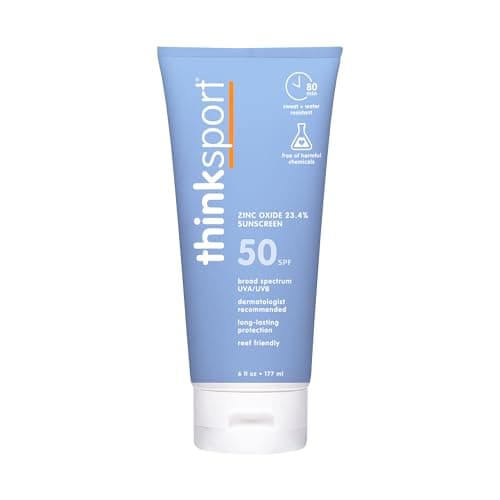
Thinksport Sunscreen SPF 50+
Thinksport · Read our Thinksport review
20% non-nano zinc oxide, nothing else filtering, and 80 minutes of water resistance. If the absorption question is why you are here, this is the straightforward answer in lotion form.
- Actives:
- 20% non-nano zinc oxide
- SPF:
- SPF 50+
- Water resistance:
- 80 minutes
- Reef status:
- Zinc only — no oxybenzone, octinoxate or octocrylene
- Best for:
- A household bottle with zinc as the only filter
What works
- Zinc oxide as the only active
- Non-nano particles
- Maximum water resistance
The trade-off
- Visible cast
- Heavy on a face
#ad We earn from qualifying purchases · Price as of October 10, 2026
02 · Shortest ingredient list
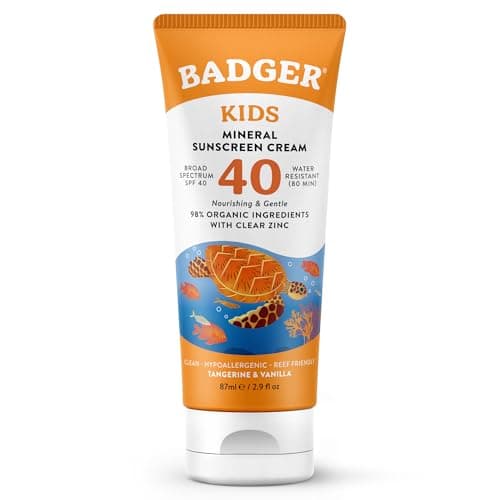
Badger Kids Sunscreen Cream SPF 40
Badger · Read our Badger review
Non-nano zinc oxide, which Badger lists at 22.5%, in a base of a handful of recognisable ingredients — the formula to choose when the whole label, not just the actives panel, is the concern.
- Actives:
- Non-nano zinc oxide, which Badger lists at 22.5%
- SPF:
- SPF 40
- Water resistance:
- 40 minutes
- Reef status:
- Zinc only — reef-relevant chemical filters absent
- Best for:
- Buyers who read the inactive ingredients too
What works
- Non-nano zinc only
- Very short ingredient list
- Fragrance-free
The trade-off
- Thick and slow to spread
- 40 minutes of water resistance
#ad We earn from qualifying purchases · Price as of October 10, 2026
03 · Lightest daily option
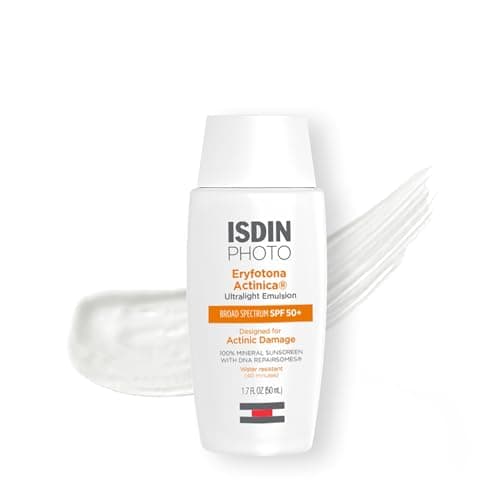
ISDIN Eryfotona Actinica Mineral Sunscreen SPF 50+
ISDIN
Zinc oxide as the sole active in a fluid that absorbs into the skin surface rather than sitting on it — proof that zinc-only does not have to mean heavy.
- Actives:
- Zinc oxide as the sole active filter
- SPF:
- SPF 50+
- Water resistance:
- Not labeled water resistant
- Reef status:
- Zinc only
- Best for:
- Daily facial wear without a mineral film
What works
- Zinc-only
- Light enough for daily use
- Fragrance-free
The trade-off
- Not labeled water resistant
- Expensive per ounce
#ad We earn from qualifying purchases · Price as of October 10, 2026
What about inhaling or swallowing it?
This is the one genuine zinc caution, and it has nothing to do with skin. Zinc oxide powder is not meant to be inhaled, which is why loose mineral powders and zinc sprays should never be aimed at a face. Spray into your hand and apply from there, or use a lotion or stick above the shoulders. The FDA's standing advice on sprays applies to mineral and chemical cans alike.
For small children the practical risk is a mouthful from a stick, not absorption. Zinc oxide is the same ingredient as most diaper creams, so a lick is not an emergency, but it is still worth keeping sticks out of a toddler's hands between applications.
The comparison that actually matters
Against the risk of skipping sunscreen. Randomised trial evidence links regular sunscreen use to fewer squamous cell carcinomas, fewer melanomas on long follow-up and measurably less photoaging. No published work links zinc oxide sunscreen use to a comparable harm. If the absorption question is what has been keeping a bottle out of your bag, zinc is the filter the regulatory record treats most favourably — and using it beats agonising over it.
Sources
- Sunscreen Drug Products for Over-the-Counter Human Use (proposed rule) — Federal Register / FDA
- Sunscreen: How to Help Protect Your Skin from the Sun — U.S. Food and Drug Administration
- Questions and Answers: FDA Requirements for Over-the-Counter Sunscreen Products — U.S. Food and Drug Administration
- Sunscreen FAQs — American Academy of Dermatology
- Daily sunscreen application and betacarotene supplementation in prevention of basal-cell and squamous-cell carcinomas of the skin: a randomised controlled trial — Green et al., The Lancet (1999)
- Reduced melanoma after regular sunscreen use: randomized trial follow-up — Green et al., Journal of Clinical Oncology (2011)
- Sunscreen and prevention of skin aging: a randomized trial — Hughes et al., Annals of Internal Medicine (2013)
Frequently asked questions
Does zinc oxide absorb into the skin?
Not to any meaningful degree. Studies applying zinc oxide sunscreen to volunteers have found the particles stay in the outer skin layer rather than reaching living skin cells. Zinc oxide works by sitting on the surface, so absorption is not part of how it functions.
Is zinc oxide sunscreen safe?
It is the sunscreen filter with the most favourable regulatory position in the US. The FDA's 2019 proposed rule placed zinc oxide and titanium dioxide in the generally-recognized-as-safe-and-effective category while asking for more absorption data on twelve chemical filters.
Is non-nano zinc oxide safer than nano?
No study has shown either to penetrate intact skin meaningfully. Non-nano particles are larger, which makes them more visible on skin; the practical difference is cosmetic rather than demonstrated safety.
Is it safe to use zinc oxide sunscreen on a baby?
Mineral sunscreen on exposed skin is the usual recommendation for babies over six months, and zinc oxide is the same ingredient as most diaper creams. Under six months, shade and clothing come first.
Should I avoid zinc oxide sprays and powders?
Do not aim either at a face. Zinc oxide powder is not meant to be inhaled, so spray into your hand and apply from there, or use a lotion or stick above the shoulders.
Read next
Mineral Sunscreen
Non-nano vs nano zinc oxide
What the non-nano claim means, why brands advertise it, and whether the distinction should change what you buy.
Reef-Safe & Ingredients
Is sunscreen toxic?
What the FDA absorption studies found, what they did not, and how to weigh it without fear-selling.
Mineral Sunscreen
Zinc oxide sunscreen, explained
What zinc oxide does, what the percentage means, and how to choose a formula you will keep using.
Mineral Sunscreen
The best zinc oxide sunscreens
Zinc-only mineral sunscreens, compared on their published zinc percentage, SPF and water resistance.
Sun Safety
How sunscreen works
The mechanism behind UV filters, the UVA and UVB difference, and why the amount applied matters so much.