Mineral Sunscreen
How much zinc oxide should be in a mineral sunscreen?
What the percentage on the actives panel actually tells you — and why it is not the protection number.
Disclosure: Spf & Shore earns commission from qualifying purchases made through links on this page, at no extra cost to you. It does not change which products we recommend. Read the full disclosure.
Zinc oxide in US sunscreens runs from roughly 10% to 25%, and the number predicts texture and white cast far more than it predicts protection. The protection claim is the tested SPF on the front of the bottle, not the percentage in the drug facts box. As a rule of thumb: 10-15% for daily facial wear, 18-22% for a general household bottle, and above 22% for long water days and surf-style coverage.
The reason the percentage is not the protection figure is that SPF is a measured outcome. Two formulas at the same zinc percentage can test several SPF steps apart depending on particle size, how evenly the zinc is dispersed and what the base does with it.
Why the percentage is not the SPF
The FDA caps zinc oxide in an over-the-counter sunscreen at 25%, and a product's labeled SPF comes from testing on human skin, not from arithmetic on the actives panel. A well-dispersed 18% zinc formula can test higher than a clumpy 24% one, because what matters is whether the particles form an even film across the skin rather than how many of them are in the tube.
So the honest reading of a zinc label is two separate facts. The SPF tells you how much UVB protection was measured when the product was applied at the test dose. The percentage tells you how much white mineral powder is in the formula — which is a forecast of how it will feel and look.
What each range is good for
| Zinc oxide | Typical use | What to expect |
|---|---|---|
| About 10-15% | Daily face SPF, under makeup, office days | Lightest textures, least cast; often blended or tinted, and usually 40 minutes of water resistance at most |
| About 16-21% | The household bottle: face and body, school runs, pools | Balanced texture, moderate cast, commonly SPF 50 with 80-minute water resistance |
| About 22-25% | Long water days, surf, high-altitude and snow | Thickest textures and the most visible film, usually with the maximum water-resistance claim |
Why high-percentage zinc shows more
Zinc oxide is a white powder, and the cast is the powder doing its job in visible light as well as ultraviolet. More powder means more visible film. Three formulation choices soften it — smaller particle sizes, better dispersion so the particles do not clump, and iron-oxide tints that cancel the grey — but none of them removes the powder, so a 24% zinc lotion will always read heavier on skin than a 12% one. Why mineral sunscreen leaves a white cast covers the chemistry.
Does non-nano change the right percentage?
Not the percentage, but the appearance at any given one. Non-nano zinc particles are larger than 100 nanometers, which scatters more visible light and therefore shows more. A non-nano 20% will look whiter than a micronized 20%. If you want non-nano and a lighter finish, go down the range rather than expecting a thick formula to disappear. Non-nano versus nano zinc oxide has the detail.
Three label traps
- A percentage on the front of the box is marketing. The regulated figure is in the Drug Facts actives panel. Check it there.
- A blend splits the total. A formula listing 12% zinc oxide and 6% titanium dioxide has 18% mineral filter, not 12%. Both numbers count toward the film you will see.
- No published percentage is not a red flag. Some brands publish only the filter name. That is legal and common; it just means you cannot predict the texture from the label and have to go by the product's own description.
Our picks in detail
01 · Lower range, daily face
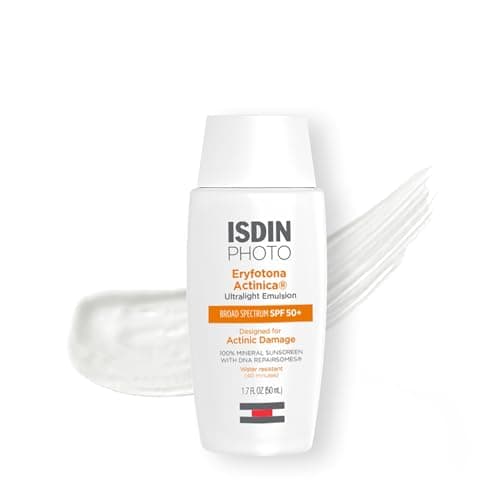
ISDIN Eryfotona Actinica Mineral Sunscreen SPF 50+
ISDIN
Zinc oxide as the sole active in a light fluid — the end of the range to choose when the product has to disappear under a routine rather than survive a swim.
- Actives:
- Zinc oxide as the sole active filter
- SPF:
- SPF 50+
- Water resistance:
- Not labeled water resistant
- Reef status:
- Zinc only
- Best for:
- Everyday facial SPF with minimal film
What works
- Light enough for daily wear
- Zinc-only
- Fragrance-free
The trade-off
- Not labeled water resistant
- Expensive per ounce
#ad We earn from qualifying purchases · Price as of October 10, 2026
02 · Middle range, household bottle
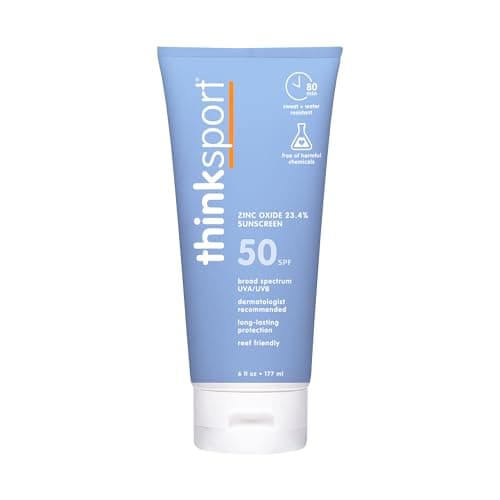
Thinksport Sunscreen SPF 50+
Thinksport · Read our Thinksport review
20% non-nano zinc with 80 minutes of water resistance — the middle of the range, where texture and water performance balance for general use.
- Actives:
- 20% non-nano zinc oxide
- SPF:
- SPF 50+
- Water resistance:
- 80 minutes
- Reef status:
- Zinc only — no oxybenzone, octinoxate or octocrylene
- Best for:
- One bottle covering face and body for a family
What works
- 20% published
- Maximum water resistance
- Large tubes
The trade-off
- Visible cast
- Heavy for daily facial use
#ad We earn from qualifying purchases · Price as of October 10, 2026
03 · Upper range, long exposure
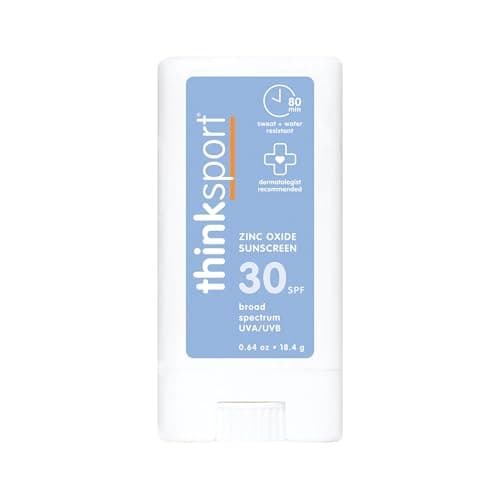
Thinksport Sunscreen Stick SPF 30+
Thinksport · Read our Thinksport review
24% zinc oxide in a stick — the high end of the range, where the thickness is the point and a visible film on a nose is a feature rather than a flaw.
- Actives:
- 24% zinc oxide
- SPF:
- SPF 30+
- Water resistance:
- 80 minutes
- Reef status:
- Zinc only — no oxybenzone, octinoxate or octocrylene
- Best for:
- Noses, ears and shoulders on a long day outside
What works
- 24% published
- 80-minute water resistance
- No spill in a bag
The trade-off
- Obvious white film
- Slow over large areas
#ad We earn from qualifying purchases · Price as of October 10, 2026
The number that matters more than any of this
How much product reaches your skin. SPF is tested at two milligrams per square centimeter — about an ounce for an adult body, and a generous blob for a face. Real-world application is routinely a quarter to a half of that, and protection falls faster than the amount skipped. A generously applied 15% zinc at SPF 50 beats a rationed 25% zinc at SPF 50 every time, which is why the pleasant formula usually wins in practice. How much sunscreen to apply.
Sources
- Questions and Answers: FDA Requirements for Over-the-Counter Sunscreen Products — U.S. Food and Drug Administration
- Sunscreen Drug Products for Over-the-Counter Human Use (proposed rule) — Federal Register / FDA
- Sunscreen: How to Help Protect Your Skin from the Sun — U.S. Food and Drug Administration
- Sunscreen FAQs — American Academy of Dermatology
- 21 CFR 201.327 — Over-the-counter sunscreen drug products; required labeling — Legal Information Institute, Cornell Law School
Frequently asked questions
How much zinc oxide should be in a mineral sunscreen?
US formulas run from about 10% to 25%, with 25% the regulatory maximum. Around 10-15% suits daily facial wear, 16-21% suits a general household bottle, and 22-25% suits long water days. The percentage predicts texture and cast rather than protection.
How much zinc oxide is needed for SPF 50?
There is no fixed figure. SPF is measured by testing the finished product on skin, so formulas at the same zinc percentage can test at different SPFs depending on particle size, dispersion and the base. Read the SPF number, not the percentage.
Is 25% zinc oxide better than 20%?
Not necessarily more protective, and definitely more visible. 25% is the FDA maximum and tends to mean a thicker product with a heavier white film. If a 20% formula tested at the same SPF, it protects the same and spreads more easily.
Why do some sunscreens not list a zinc oxide percentage?
Publishing the concentration is not mandatory, so some brands list only the filter name in the actives panel. It is legal and common; it simply means you cannot forecast the texture from the label.
Do zinc and titanium dioxide percentages add up?
For the purposes of texture and cast, yes — a blend listing 12% zinc oxide and 6% titanium dioxide carries 18% mineral filter in total, and will look and feel closer to an 18% product than a 12% one.
Read next
Mineral Sunscreen
The best zinc oxide sunscreens
Zinc-only mineral sunscreens, compared on their published zinc percentage, SPF and water resistance.
Mineral Sunscreen
Non-nano vs nano zinc oxide
What the non-nano claim means, why brands advertise it, and whether the distinction should change what you buy.
Mineral Sunscreen
Why mineral sunscreen leaves a white cast
The physics behind the cast, the three levers formulators have, and which one actually solves it.
Mineral Sunscreen
Zinc oxide sunscreen, explained
What zinc oxide does, what the percentage means, and how to choose a formula you will keep using.

Sun Safety
How much sunscreen to apply
The measures by body area, and why under-application costs more protection than it seems.